by kelsey | Jul 26, 2012 | Etc.
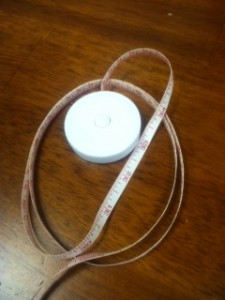
Body Mass Index or BMI is a part of our regular assessments when you come in to see me, the doctor, or participate in STRIVE 2 Survive. It’s part of our assessments as it’s a fairly reliable indicator for fatness in most adults and it tells us where you’re at on the spectrum in regards to your height to weight ratio. BMI is calculated from your height and weight and is an inexpensive measurement tool compared to other measurements for body fat such as underwater weighing or the bod pod. BMI does not not take muscle mass or bone structure into consideration thus it’s not always the best measurement for everyone. It is not as beneficial with athletes and the elderly.
There are several categories which help us determine where you are at at the spectrum of underweight to obese. The categories include:
- Underweight: BMI below 18.5
- Normal weight: 18.5 to 24.9
- Overweight: 25.0 to 29.9
- Obese: 30.0 and above.
Those people with very low or very high BMI’s are at highest risk. Even though BMI is used as an assessment tool, it’s just one factor that contributes to the big picture of your overall health and wellbeing. As I said earlier, we use BMI in STRIVE 2 Survive, but we also get body fat percentage, fat mass, and muscle mass by using our body composition analyzer scale. Other measurements we find valuable are blood pressure, waist circumference, and lab work such as the lipid panel and glucose. A higher waist circumference can be an indicator of heart disease as those who carry their weight in their mid section (apple shape) are at higher risk for heart disease compared to those who carry their weight in their buttocks and thighs (pear shape).
If you would like to calculate your BMI and learn more about this measurement, check out this website for more information: http://www.nhlbisupport.com/bmi/.
If your BMI is not desirable and you’d like to work on improving this, eating healthy, practicing portion control, and engaging in daily activity are tools for success. With STRIVE 2 Survive we like to look at the big picture of wellness which is why we get the variety of measurements pre-program and post-program. Sometimes we get frustrated with the scale as the number doesn’t always want to move like we want it to, but we have to remember that our positive lifestyle changes can be improving things inside too!
-Kelsey
by kelsey | Jul 25, 2012 | Etc.
Lately, I have had several people tell me that they enjoy reading our blog or that they found a specific post really intriguing or valuable to them. Dr. Dan and I really enjoy spreading the word about health, wellness, nutrition, and activity and we enjoy the feedback from you! Many of you get our posts directly into your email, some learn more through our Facebook page, and many just browse our site on a regular basis. No matter how you decide to connect with us, please know we appreciate you! You are the reason we are so passionate about our work with STRIVE 2 Survive and promoting healthy lifestyles! We typically write about relevant topics related to our lives, the news, etc, however we certainly can write about anything you desire to learn more about! If you have questions related to wellness, health, nutrition, or activity please share them with us and we’ll be sure to get them answered through our blog! You can contact us by commenting on the posts, emailing us, calling us, or writing us on Facebook.
Our program continues to evolve and improve as time goes on and we base alot of our improvements on our participant’s feedback and requests. We are so excited to be starting our fall program September 4th and are eager to work with another great group! We already have a list of participants excited to start, so if you are interested in learning more and getting enrolled, be sure to contact us!
Thanks for giving us purpose to continue sharing our passion about wellness with you!
-Kelsey
by kelsey | Jul 24, 2012 | Food, Heart Health, Wellness/Health
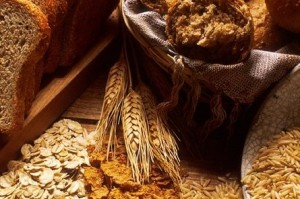
Lately, the farmers have been busy harvesting their grain crops such as oats and wheat. I always marvel at this process as what they’re doing is directly contributing to our food sources and availability. Without their hard work, our food chain would be greatly affected. Grains are an excellent source of energy for our brain and central nervous system. The whole grains are especially beneficial for promoting heart health due the fiber content. The average American only eats about 1 serving of whole grains a day and a serving is equivalent to a slice of bread, a cup of cereal, or a 1/2 cup of rice…which means that’s not much! We recommend at least half or your grain intake to be whole grains which should be at least 3 servings.
Whole grains are unrefined meaning they have all three parts still intact. Refined grains go through a process where the bran and germ are removed, thus extending shelf life and giving them a finer taste. Since the whole grains do not go through any processing and their germ (inner layer) and bran (outer layer) are still intact, they are a better source of fiber and other essential vitamins and minerals, especially selenium, potassium, and magnesium. When selecting a whole grain product, it’s important to look at the ingredient list and select a product that’s first ingredient is “whole” such as “whole grain,” “whole wheat,” etc. If the first ingredient says refined or enriched, that means that product is truly not whole grain.
Whole grains are found in brown and wild rice, whole wheat flour, oats, popcorn, rye, and whole wheat pasta. Like I’ve mentioned before, balance is truly key to a healthy diet, so achieving a balance of whole grains, lean proteins, fruits and vegetables will not only fuel your body but will aid in disease prevention. The fiber found in whole grains is not only beneficial for heart health, but also aids in stability for blood sugars, digestive health, and satiety. Next time you go to the store, make sure you take the extra few seconds to double check your label to ensure you’re getting a whole grain product…and be sure to thank our farmers for helping harvest our food supply!
-Kelsey
by kelsey | Jul 19, 2012 | Cooking Tips, Food, Weight Management, Wellness/Health

As I mentioned in my post yesterday, I am proud to be a part of South Dakota Team BEEF which is sponsored by the SD Beef Council. Team BEEF is a group of runners and health advocates who recognize the benefits nutritionally of lean beef and the important role this top notch protein can play in training. As members of Team BEEF, you get a running jersey to promote Team BEEF and reimbursement for several sponsored races. I first learned of Team BEEF from a good friend and fellow dietitian who helped start Wisconsin’s Team BEEF when she was in school there. As I learned more, I knew I had to get involved as I am truly passionate about health and wellness and am an advocate for lean beef protein. Yes, I may be little biased because I am the wife of a cattle rancher and that’s our way of living, however if you truly examine the research and evidence regarding beef protein, there truly is a place for it in our diets…as long as you are selecting the lean cuts the majority of time.
Did you know that beef is 20% leaner than it was about 15 years ago? There are at least 29 cuts of lean beef which means they meet the government guidelines for lean, meaning each cut has less than 10g of total fat, less than 4.5 g of saturated fat, and less than 95mg of cholesterol (in a 3 oz serving). Here are some tips for you to make beef a part of your heart healthy meals:
- Look for key words such as “round” or “loin” …these are typically leaner cuts
- Choose 90% or greater lean beef. This means in a 3oz serving there is less than 5g of fat in it.
- Use healthy cooking methods such as grilling, broiling, baking, roasting, or braising. The less tender cuts can be marinated in a tenderizing marinade such as salsa or light Italian dressing.
- Trim the fat! Trimming the fat before cooking will help eliminate some of the fat from the cut.
- Cook with fresh ingredients such as lemon juice, peppers, onions, garlic, and herbs instead of adding extra fat to the cut.
- Practice portion control. Select the 3-5 oz serving over the 10oz.
Balance is key to a healthy diet, so be sure to include your fruits and veggies and whole grains along with your lean meat to create a healthy plate. As of a just a few months ago, all meat is required to have the nutrition content (label) posted by it in the grocery store. Be sure to use this when you’re selecting your cuts of meat and pay special attention to the total fat and saturated fat content. If you want to learn more about the benefits of beef and explore healthy recipes check out these websites: www.beefnutrition.org and www.beefitswhatsfordinner.com.
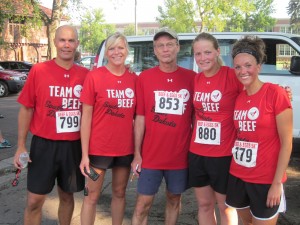
Below is a picture of some of the SD Team BEEF members after the Beef & Eggs 5k.
-Kelsey
by kelsey | Jul 18, 2012 | Goals, Wellness/Health
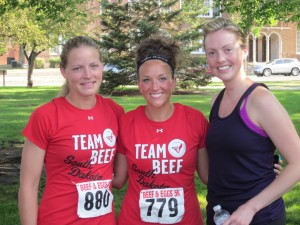
Many of our regular readers and my friends and family know about my heart issue that resulted in me having to readjust my fitness goals and aspiration. For those new readers of our STRIVE 2 Survive blog, you will have to refer back to a previous post (https://s2sbrownclinic.com/2012/05/the-reality-of-goal-setting/) to get more details. In short, my hopes and dreams of running a half marathon were diminshed when I learned my heart couldn’t take that amount of vigorous activity due to a congenital valve issue. This was a major let down for me, but I am a realist and I knew I had to move on as it wasn’t worth dwelling over and it definetely wasn’t worth dying over!
After a lot of self reflecting, I decided I needed a different goal that was better for my heart and for my spirit. Thus, I decided to sign up for the Beef & Eggs 5k race in Brookings. I also became a part of South Dakota Team BEEF thus promoting two passions of mine: running or activity in general and promoting the benefit of lean protein found in 29 cuts of lean beef. This last weekend, I fulfilled this goal and ran the 5k without any chest pain or shortness of breath. I ran with two of my best friends from college who were on the SDSU Equestrian Team with me and I couldn’t have asked for better support. My friend Anna, who is on the left of me in the picture, also a member of SD Team BEEF and my friend Katie, on the right, were a great support system for me. We weren’t too focused on time, but rather enjoyed each other’s company while doing something we all love.
Setting new goals isn’t always an easy task, especially when you didn’t meet the previous goal, however staying positive about your aspirations and being real about what you are capable of doing will help you. Setting goals pushes you to achieve more in life. In addition, it’s important to reward yourself when meeting the goals. My reward for fulfilling my new goal was a day spent with my friends after the race and it was totally worth it! I am thankful for having a great support system to help me get through the tough times and celebrate the good times.
Tomorrow I will discuss SD Team Beef, so stay tuned!
-Kelsey
