by kelsey | Aug 8, 2012 | Diet, Food, Weight Management

I’m sure everyone has experienced a time when you get a craving for a specific food and it’s very hard to give into it. Whether it may be pizza, chips, icecream, or chocolate, many times our cravings are so intense, it’s hard not to give in! Research is still inconclusive about whether cravings are physiological or pyschological and both factors may be causes. Sometimes our cravings can be so intense and overwhelming which results in overindulgence which then results in guilt. Those that follow very restrictive diets that cut out specific food groups can get trapped into a vicious cycle of indulging, overeating, and then feeling very guilty and bad about those actions. A balanced, portion controlled diet that has small amounts of foods but sometimes includes those high fat, high sugar, high calories foods (in moderation) can be easier to maintain as there is not elimination in this diet. Moderation and portion control are truly essential to a healthy diet and can help you stay in control of those behaviors and desires and that viscious cycle of cravings, over-indulging, and guilt.
Here are some tips to help you manage your food cravings:
- Ignore the craving: if you feel a craving coming on, wait for 20 minutes and then decide if you should give in. Usually cravings are short-lived so if you can distract yourself for a little while, the feeling may go away.
- Find a healthier option: Feeling like potato chips? Find a kind that is lower in fat such as the baked chips. Feeling like pizza? Make a mini pizza with thin crust and add some great veggies and lean meats. Feel like something crunchy? Try carrots and light dip or a crisp apple.
- Choose single servings: Buy just one cookie rather than the whole box. 100 calorie packs are a nice way to practice portion control, however the key is only having one pack, not 10. In addition sometimes these foods are not the healthiest, so you will want to choose wisely and carefully.
- Practice a consistent intake: Planning your meals and snacks throughout the day and eating every couple of hours can decrease the desire to over-eat and indulge. You may have to plan ahead and have snacks or foods readily available if you’re on the run alot.
- Distract yourself: take a walk, call a friend, or work on a hobby. Sometimes redirecting your thoughts and behaviors will help you get through the craving without giving in.
- Keep a food journal: Journaling your intake not only helps with choices and portion control, but it can also help you recognize your feelings and desires about foods. Record your emotions, how long the craving lasted, what food you craved, and how you handled the situation. You may also want to pay attention to the time of the day the cravings occur. By journaling, you’ll be able to recognize patterns and be better prepared to handle these situations in the future. Keeping a food journal is a very valuable tool and something we provide at our first meeting with STRIVE 2 Survive!
-Kelsey
by kelsey | Aug 7, 2012 | Etc.
Wow, is it just me or has summer flown by! It’s hard to believe that school will be starting in a few weeks and everyone will be getting back into the swing of things with school year activities. We are excited to start our fall off in a great way! Our fall STRIVE 2 Survive program is set to start Tuesday, September 4th. Our first meeting at the County Fair Banquet Hall at 5:30pm, however we encourage you to pre-register to ensure your spot!
STRIVE 2 Survive was initially started by Dr. Dan when we worked in Clear Lake and has evolved over the years to become a very well-rounded, multi-discplinary approach to wellness and promotion of healthy living. We meet 6 out of the 12 weeks (the weeks you don’t meet you get a take home lesson) and lab work and body composition testing are included at the beginning and end of the sessions to provide a variety of measurements for you to track progress.
STRIVE 2 Survive has had many success stories that include improved lab work, weight, strength, blood pressure, and overall health and well-being. Our program applies to all who have a heart beat, so if you are wanting to learn more about eating healthy, activity, health, and wellness we’re here for you!
For more details, be sure to check out our calendar, program details, and STRIVE participant feedback under the “INFO” tab on our website. You are also welcome to contact us through the contact link, email (strive2survive@brownclinic.org) or call us at 886-8482 to for more information and to reserve your spot!
-Kelsey
by kelsey | Aug 2, 2012 | Food, Weight Management, Wellness/Health
Breakfast is one of the most important meals of the day! Yes, you have probably heard this before, but are you a breakfast eater!? Having a good breakfast is a great way to start out the day. It’s not only important for our body, but our mind too. Many times we’ll have excuses such as I was running late, I didn’t feel like eating, I’m not hungry in the morning, and this actually accounts for about a 1/4 to a 1/3 of the population! Starting the day without breakfast is like driving your car on a low tank of gas. We know we can’t go on forever on a low tank of gas, so we shouldn’t do that to our bodies either! Those that skip breakfast tend to snack more on high fat and lower nutritious foods…and are more likely to overeat at lunch because they are over-hungry. Studies have also shown that those working on weight loss are more successful when they eat breakfast as this really jump starts their metabolism and starts their day off right.
So what should you eat for breakfast? It’s important to get a balance at your meals and especially include a source of protein and a whole grain as these provide satiety. Here are some examples for you:
- Ready-to-eat cereal (>3g fiber, <2-3g fat, a ratio of greater than 4 g carbohydrate:1 g sugar)
- Hot cereal (oatmeal)
- Bagel with low-fat cream cheese or peanut butter
- Yogurt with sliced fruit
- Fruit and yogurt smoothie
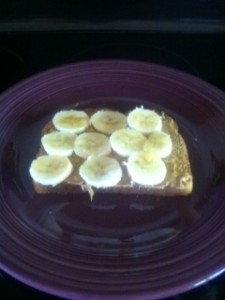
- Peanut butter or hummus on whole-wheat toast (my favorite! I included a picture of my favorite PB toast with bananas and honey)
- Breakfast quesadilla with low-fat cream cheese and sliced fruit
- Breakfast burrito or taco
- Toasted whole-wheat English muffin with lean ham and low-fat cheese
- Toasted pita with scrambled egg and low-fat cheese
- Low-fat milk and 100% fruit
If you are one who is not a fan of breakfast but understands the importance of it, I encourage you to try a variety of these options and see which one works best for you. I also encourage you to plan ahead. You may need to wake up 5 minutes earlier to fit breakfast in or make your smoothie the night before so all you have to do it pull the bottle or container out of the freezer or fridge in the morning and drink it on your way to work. Starting your day with a full tank will provide long lasting benefits to you and your body!
-Kelsey
by kelsey | Aug 1, 2012 | Etc., Exercise, Weight Management, Wellness/Health

I usually leave the activity talk on this blog up to Dr. Dan, however lately I have had a lot of questions and discussion regarding activity with my patients that I thought I’d discuss a little bit on here as well. As many of you know, it’s hard to tackle wellness with just diet or just activity, thus to be most successful you really need to work on both! Often times, people will tell me that they are super busy during the day and their job requires them to be on their feet so that counts as exercise. Having a job where you’re on your feet is better than a desk job as we naturally burn more calories standing than sitting, however that doesn’t necessarily mean it counts as moderate activity.
At least 150 minutes of moderate activity is recommended each week. We recommend it by week as it can be spread throughout your days (example 30 min Monday, 40 min Tuesday, 60 min Wednesday, etc)…and it just has to be 10 minutes at a time! Moderate activity has been shown to be beneficial for our cardiovascular health as well as aiding in disease prevention and weight management. The difference between moderate activity and your daily chores and work duties is that moderate activity gets your heart rate up high enough to result in these benefits. You can certainly check your heart rate and figure out your range, however the easiest way to determine you are reaching that moderate level is by using the talk test. Moderate activity involves getting your heart rate up high enough that you can talk (in between breaths), but you are unable to sing. If you are able to sing and talk as you normally would, then your heart rate is not at that moderate level.
Here are some examples of moderate activity:
- Gardening for 30-45 minutes
- Shoveling snow for 15 minutes
- Stair walking for 15 minutes
- Washing windows and floors for 45-60 minutes
- Walking 2 miles in 30 minutes (1 mile in 15 minutes)
- Dancing fast (social dancing) for 30 minutes
- Swimming laps for 20 minutes
- Jumping rope for 15 minutes
Just remember that every bit counts so if you are only able to do little bits of activity throughout your day, that’s better than nothing! The key is to keep moving!!
-Kelsey
by kelsey | Jul 31, 2012 | Exercise, Wellness/Health
I have discussed my involvement with South Dakota Team Beef in previous posts and my passion for promoting lean beef and physical activity. After the Beef and Eggs 5k race I had the opportunity to visit with Bruce Falk, editor for the Tri-State Neighbor. He is also a member of SD Team Beef and shares similar interests. He was interested in learning more about my job as a dietitian and being in a producer family in the beef industry. One of his questions inquired about my husband’s activity…which brought us to the very popular limitation for exercise: TIME! As a farmer and rancher, Adam spends most of the time when the sun is out working, which means in the summer the days start early and end later. Whether you’re a farmer, rancher, or a business man, we all have one thing in common: everyone is busy! When we’re busy, it’s easy to push off the exercise until you have more time.
Time management is key to success with health and wellness. First off, it’s important to make a commitment to exercising. Next, you’ll want to focus on ways to add exercise into your routine. I suggest looking at your calendar for each week and plan it into your daily schedule. If you think of it like a work meeting you have to attend, you’ll be less likely to skip it and it will eventually become second nature or a habit to do it. Most importantly, you want to schedule it into your day when it’s convenient for you. If you are not a morning person, setting your alarm to work out at 5am will not be ideal for you! You also want to consider engaging in an activity that you enjoy. I am not big into swimming (despite knowing how), so if I had to swim daily, I would dread every minute of it! Whereas my preferred activities are biking and running as I enjoy them. One other aspect to consider is if you like to exercise with a buddy or alone. Some may enjoy going alone as it can be a quiet time for them, but others may prefer a buddy to help them stay motivated. The key is finding a solution that works best for you!
Setting goals is a good tool to help with accountability. This is something we will do in our first lecture with STRIVE 2 Survive on September 4th.
Another concept we discuss regularly in my house and with my patients is the difference between being “busy” and aerobic activity…stay tuned to tomorrow’s post to learn more!
If you want to read more about the article I am featured in click the link below:
http://www.tristateneighbor.com/news/opinion/bruce_falk/article_a19c86b0-d766-11e1-9521-001a4bcf887a.html
-Kelsey
