by kelsey | Aug 21, 2012 | Etc.

Did you fall off the wagon with your wellness goals this summer due to summer festivities and lack of activity? We can help you! Two weeks from today, we’ll be kicking off our fall is an exciting way with our fall session of STRIVE 2 Survive. Our first session starts September 4th at the County Fair Banquet Hall at 5:30pm. Be sure to check out our website for more details and contact us today to get signed up! It’s never too late to put YOU first to achieve a healthier lifestyle!
by kelsey | Aug 16, 2012 | Etc.

It’s hard to believe summer is close to an end which means school starts again and we get back into helping people get healthy inside and out through STRIVE 2 Survive. The last two mornings, I have had the opportunity to visit with the folks at KXLG radio and Jeff Anderson with 1480AM to promote our program. A common question people ask about STRIVE is what kind of success we have seen. Since we are not a program like the Biggest Loser that focuses on total weight loss in a short amount of time, we measure our success by cholesterol, blood pressure, and blood sugar improvements as well as weight, body fat percentage, and waist circumference improvements. We actually want to see a slower and steady weight loss rather than a fast, large weight loss as the person who has the slow and steady weight loss will be more apt to keep it off in the long run. Under our “info” tab, we have highlighted many of our participant’s success, but I thought I’d include it here as well to help show the success of our program in regards to disease prevention and wellness.
Female Participant (Age 30-35): lost 19 lbs, improved her cholesterol by 45 points and triglycerides by 95 points, also lost 2 inches off her waist!
Female Participant (Age 50-55): lost 13 lbs (lost 42 lbs total over the last 6-8 months by working with Kelsey), lost 5.8% body weight, improved blood sugars and cholesterol, lost 2 inches off her waist!
Male Participant (Age 55-60): Lost 36.8 lbs, 10.75% of his body weight, improved total cholesterol by 10 pts (was already in a normal range), triglycerides by 65 points, dropped blood pressure into normal range from hypertension range, lost 3 inches on his waist, and reduction in his body fat percent and fat mass!
Female Participant (Age 35-40): Lost 21 lbs, 12% of her body weight, improved her total cholesterol by 66 points, LDL cholesterol by 61 points, blood pressure to a more normal range, dropped 3 ½ inches off her waist and her BMI into the healthy weight category from overweight, along with greatly improving her body fat percent and fat mass!
Female Participant (Age 60-65): lost 3 lbs, but improved her cholesterol by 50 points and dropped her LDL by 40 points!
Male Participant (Age 65-70): lost 10 lbs, improved his total cholesterol and LDL by 25 points, dropped sugars 20 points and went from prediabetic to under the range, and lost 2 ½ inches on his waist!
We are so excited to start the fall with another great group of people all working to improve their health and wellness. It’s a perfect time to put YOU first!! Contact us today to get enrolled!
-Kelsey
by kelsey | Aug 15, 2012 | Cooking Tips, Diet, Food, Weight Management
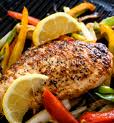
A popular topic of discussion with my patients is fat content and ways to reduce fat in our diets. You have read about lean beef options in previous posts, but it’s also important to discuss white meat poultry compared to dark meat. Many prefer the chicken thigh over the breast due to the flavor and taste. The dark meat certainly may have more flavor, but it also has more calories, fat, and saturated fat all contributing to the flavor. A 3 oz portion of a chicken breast without the skin contains about 3 g of fat, <1g sat fat and about 140 calories. A similar serving of dark meat has about 170 calories, 9 g of fat and 3 g of saturated fat. The nutritional composition of dark meat is very similar to that of a T-bone steak. Thus, the white meat has less calories and significantly less fat.
Choosing lean meats is going to help reduce your risk for heart disease, but it’s also important to be mindful of your portion sizes to help keep your calories balanced. Keeping your protein to a quarter of your plate or about 3-4 oz will provide your body with the right amount of nutrients, while not breaking the calorie bank. In addition, be sure always include a balance at your meals with a quarter of your plate whole grains and half your plate fruits and veggies.
-Kelsey
by kelsey | Aug 14, 2012 | Diet, Weight Management

Eating out can be a challenge as you aren’t sure how the foods are prepared, what types of foods are used, and what the food prep consists of. You may question, are the healthier looking choices sometimes worse for you? A salad over a hamburger should always be healthier, right? We find that in some scenarios this is not the case at all. Because of added seasoning, dressing, and breading the choices that appear to be healthier can have more calories. A way to avoid some of these unnecessary calories is to ask for the dressing on the side, or ask for your meats grilled instead of fried. If you eat at a restaurant regularly it’s not a bad idea to look at their menu online for their nutritional values. This could help you make a healthier decision when going out to eat. In addition, you may also consider using a pocket guide book such as Calorie King’s book (www.calorieking.com) or using an app on your smart phone. Besides making a good choices, portion control is essential! Take half of your meal home or share with a friend or family member. That alone will cut down on calories, fat, and sodium.
Here is a fun quiz to help you compare some foods and see which have more calories. The results may surprise you.
1) Applebee’s Oriental Chicken Salad (with dressing) Vs. Applebee’s Bacon Cheeseburger
2) McDonalds the Big Breakfast with Hotcakes Vs. McDonalds Angus Delight
3) McDonalds Cheeseburger Vs. McDonalds Chocolate Shake
4) Culvers Fresh Fried Chicken Dinner Vs. Culvers Chicken Sandwich Value Basket
5) Arby’s Medium Curly Fries Vs. Arby’s Pecan Chicken Salad Sandwich
********************************************************************
Answer #1 The Bacon Cheeseburger has fewer calories at 970 calories compared to the Oriental Chicken Salad that has 1390 calories.
Answer #2 The Angus Delight has fewer calories at 750 compared to the Big Breakfast with Hotcakes that has 1090 calories.
Answer #3 The Cheeseburger has 300 calories compared to a Chocolate Shake that has 570 calories.
Answer #4 The Chicken Sandwich Value Basket is 422 calories compared to the Fresh Fried Chicken Dinner that has 2220 calories.
Answer #5 The Curly Fries are 540 calories compared to the Pecan Chicken Salad Sandwich that has 840 calories
*This blog post was prepared by SDSU Dietetic Student Megan Bren.
-Kelsey
by kelsey | Aug 9, 2012 | Diet, Weight Management, Wellness/Health

Have you been cheering Team USA on in the Olympic games? The Olympics are one of my favorite times as I really enjoy watching our top notch athletes perform, I enjoy watching the variety of sports, and it’s also fun to cheer them on and support the USA! Nutrition plays a key role in helping the athletes perform at their highest abilities. Many are genetically pre-disposed for their sports but they also have to put a lot of time and energy into training of which nutrition become very important. Most athletes work with a sports dietitian to help them figure out the best eating plan to help them perform. Nutrition needs vary depending on the activity, however they all have one main focus which is achieving and maintaining a lean body mass to give them the appropriate endurance, agility, energy, and skills they need.
You may have heard that the greatest Olympian of all time, Michael Phelps, eats around 8,000-10,000 calories a day. Swimming takes a lot of energy and in order for him to perform well, he must fuel his body with appropriate calories and nutrients. Carbohydrates are very important for energy as they are needed to maximize glycogen (storage form of glucose) stores before training and competition, and replenish the stores after exercise. In addition, protein intake is very important to help replenish muscle cells and help provide strength to the athlete. Since each sport and each athlete are different, a dietitian can help individualize their diet plans. Proper nutrition can turn a mediocre athlete into a great one, thus it’s really important for the athlete to have this a part of their training regime.
Even though we may not be Olympic athletes, this concept applies to us as well. If we provide ourselves with the appropriate energy needs and balance of nutrients, we will perform at our highest abilities and our body will be well fueled to prevent disease, aid in longevity, and allow us to enjoy a long and healthy life! Remember, food is fuel!
-Kelsey
