by kelsey | Aug 21, 2012 | Etc.
Did you fall off the wagon with your wellness goals this summer due to summer festivities and lack of activity? We can help you! Two weeks from today, we’ll be kicking off our fall is an exciting way with our fall session of STRIVE 2 Survive. Our first session starts September 4th at the County Fair Banquet Hall at 5:30pm. Be sure to check out our website for more details and contact us today to get signed up! It’s never too late to put YOU first to achieve a healthier lifestyle!
by Dan | Aug 19, 2012 | Exercise, Family, Motivation, Wellness/Health
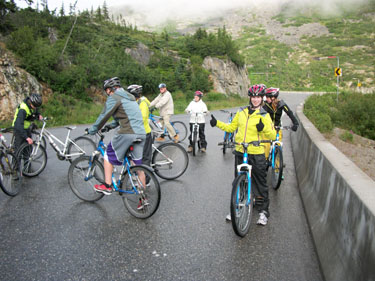
When we stopped on the cruise in Skagway, the 5 of us went on a biking excursion. We went to the summit, which is the road that that is taken as a means of communication to the other 48 states. We did not have to do a lot of pedaling for the first several miles, but really had to be in control of the brakes. It rained on and off, so we have rain gear. As you can see by Molly, at our first stop, we were having a good time. We had passed the steepest point, but we were ready to go over a bridge, and I for one will admit, I could not look down as we went over it. I just kept saying, “keep your eyes straight ahead!”.

This was one of the views we had coming down. Mountains in the background, clouds, of which several times we were riding our bikes through. Very scenic, but as we got past the initial part of the summit, then we had to be pedaling the bikes.
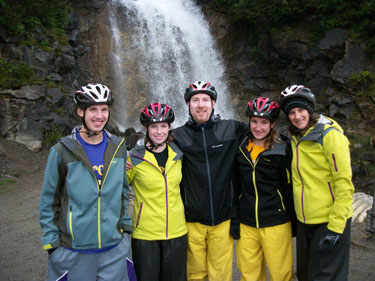
This was one of our stops along the way. Very cool waterfall in the background. We were not used to having to ride in warmer clothes, much less all of the rain gear, but stayed nice and dry. Very fun ride, one we will all remember. And once again, a great way to do sightseeing!
Keep moving everybody, and enjoy the scenery along the way!
Dr. Dan
Consecutive Exercise Day #: 1788
by Dan | Aug 16, 2012 | Exercise, Family, Motivation, Wellness/Health

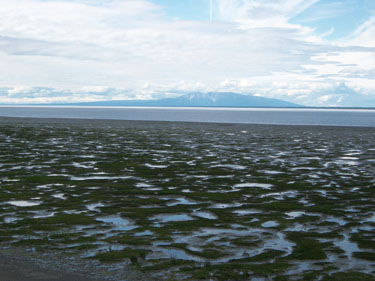
The first day we got to Alaska, in Anchorage, we rented bikes that afternoon and went explorer along the coast line. We could see the back on Mt Mckinley, which was 100 miles away. This was going to be our next stop the following day, to see up close. The girls had a ball because they got to ride a bike for 2. It was a great way to get out and explore, and see the sites, and get our exercise for the day. We all had a good time with this. Here are some of the views of Mt Mckinley from the bike perspective.
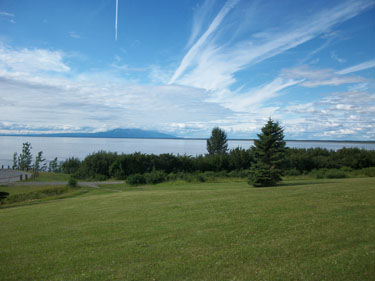
Keep moving everybody. Will continue with the Alaska exploration.
Dr. Dan
Consecutive Exercise Day #: 1785
by kelsey | Aug 16, 2012 | Etc.
It’s hard to believe summer is close to an end which means school starts again and we get back into helping people get healthy inside and out through STRIVE 2 Survive. The last two mornings, I have had the opportunity to visit with the folks at KXLG radio and Jeff Anderson with 1480AM to promote our program. A common question people ask about STRIVE is what kind of success we have seen. Since we are not a program like the Biggest Loser that focuses on total weight loss in a short amount of time, we measure our success by cholesterol, blood pressure, and blood sugar improvements as well as weight, body fat percentage, and waist circumference improvements. We actually want to see a slower and steady weight loss rather than a fast, large weight loss as the person who has the slow and steady weight loss will be more apt to keep it off in the long run. Under our “info” tab, we have highlighted many of our participant’s success, but I thought I’d include it here as well to help show the success of our program in regards to disease prevention and wellness.
Female Participant (Age 30-35): lost 19 lbs, improved her cholesterol by 45 points and triglycerides by 95 points, also lost 2 inches off her waist!
Female Participant (Age 50-55): lost 13 lbs (lost 42 lbs total over the last 6-8 months by working with Kelsey), lost 5.8% body weight, improved blood sugars and cholesterol, lost 2 inches off her waist!
Male Participant (Age 55-60): Lost 36.8 lbs, 10.75% of his body weight, improved total cholesterol by 10 pts (was already in a normal range), triglycerides by 65 points, dropped blood pressure into normal range from hypertension range, lost 3 inches on his waist, and reduction in his body fat percent and fat mass!
Female Participant (Age 35-40): Lost 21 lbs, 12% of her body weight, improved her total cholesterol by 66 points, LDL cholesterol by 61 points, blood pressure to a more normal range, dropped 3 ½ inches off her waist and her BMI into the healthy weight category from overweight, along with greatly improving her body fat percent and fat mass!
Female Participant (Age 60-65): lost 3 lbs, but improved her cholesterol by 50 points and dropped her LDL by 40 points!
Male Participant (Age 65-70): lost 10 lbs, improved his total cholesterol and LDL by 25 points, dropped sugars 20 points and went from prediabetic to under the range, and lost 2 ½ inches on his waist!
We are so excited to start the fall with another great group of people all working to improve their health and wellness. It’s a perfect time to put YOU first!! Contact us today to get enrolled!
-Kelsey
by kelsey | Aug 15, 2012 | Cooking Tips, Diet, Food, Weight Management
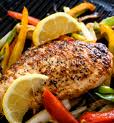
A popular topic of discussion with my patients is fat content and ways to reduce fat in our diets. You have read about lean beef options in previous posts, but it’s also important to discuss white meat poultry compared to dark meat. Many prefer the chicken thigh over the breast due to the flavor and taste. The dark meat certainly may have more flavor, but it also has more calories, fat, and saturated fat all contributing to the flavor. A 3 oz portion of a chicken breast without the skin contains about 3 g of fat, <1g sat fat and about 140 calories. A similar serving of dark meat has about 170 calories, 9 g of fat and 3 g of saturated fat. The nutritional composition of dark meat is very similar to that of a T-bone steak. Thus, the white meat has less calories and significantly less fat.
Choosing lean meats is going to help reduce your risk for heart disease, but it’s also important to be mindful of your portion sizes to help keep your calories balanced. Keeping your protein to a quarter of your plate or about 3-4 oz will provide your body with the right amount of nutrients, while not breaking the calorie bank. In addition, be sure always include a balance at your meals with a quarter of your plate whole grains and half your plate fruits and veggies.
-Kelsey
