by kelsey | Aug 22, 2012 | Cooking Tips, Food, Wellness/Health

With everyone getting back into the groove of school this week, it means children are going back to the cafeteria. The importance of talking with your children about nutrition is crucial to their health. Children need to be able to make healthy decisions on their own. There are several steps a parent can make when helping their child go back to school.
Look over the menu: Review the weekly or monthly school menus with your child and decide which meals they like and dislike. For the days your child decides to eat at school help them distinguish the healthier choice, like choosing fruit instead of a cookie. Studies have shown letting your child help in the decision-making process makes them more likely to follow through with the decision.
Packing your own lunch: Make sure you’re packing meals with enough nutrients to power your child through the rest of their school day. Let your child be a part of the lunch packing process whether if it is making the sandwich or packing fruits into a bag. Pack food your child likes, because if they don’t eat it at home they are not likely to eat them when you’re not around.
Follow up at home: Make sure to follow up their lunch with an equally healthy dinner. Having a well balance meal at every meal is very important. A child who eats healthy at home is more likely to make healthier choices when they are on their own.
Tips for Packing Healthy School Lunches:
- Plastic bags and containers will really help with portions while making a sack lunch.
- Keep in mind that they will not be eating right away and to keep the refrigerated foods cool to keep from spoiling. For example, dairy products such as yogurt, will need a cool pack.
- Pack the lunch the night before with leftovers from dinner to save time in the morning.
- Make sure to include the child while making lunch and give them healthy choices to choose from.
- Try to choose less sugary drinks, like skim milk instead of chocolate milk or crystal light instead of a high sugar juice.
Keeping the lunches safe by keeping all the food at the correct temperatures. Pack cold items in an insulated lunch box with a frozen pack. Keep warm soups in a thermos, make sure the thermos is clean and use very hot water.
Sandwich Ideas
Whole wheat bread with deli meat (try to avoid bologna, pepperoni, and salami)
Peanut butter and jelly sandwich
Bagel with cream cheese or peanut butter
Crackers and cheese
Pita with hummus
Ham and cheese rolled up in a whole wheat tor-tilla
Crackers and cheese
*This blog post was written by Megan Bren, SDSU Dietetic Student
-Kelsey
by kelsey | Aug 15, 2012 | Cooking Tips, Diet, Food, Weight Management
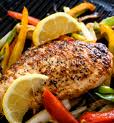
A popular topic of discussion with my patients is fat content and ways to reduce fat in our diets. You have read about lean beef options in previous posts, but it’s also important to discuss white meat poultry compared to dark meat. Many prefer the chicken thigh over the breast due to the flavor and taste. The dark meat certainly may have more flavor, but it also has more calories, fat, and saturated fat all contributing to the flavor. A 3 oz portion of a chicken breast without the skin contains about 3 g of fat, <1g sat fat and about 140 calories. A similar serving of dark meat has about 170 calories, 9 g of fat and 3 g of saturated fat. The nutritional composition of dark meat is very similar to that of a T-bone steak. Thus, the white meat has less calories and significantly less fat.
Choosing lean meats is going to help reduce your risk for heart disease, but it’s also important to be mindful of your portion sizes to help keep your calories balanced. Keeping your protein to a quarter of your plate or about 3-4 oz will provide your body with the right amount of nutrients, while not breaking the calorie bank. In addition, be sure always include a balance at your meals with a quarter of your plate whole grains and half your plate fruits and veggies.
-Kelsey
by kelsey | Aug 8, 2012 | Diet, Food, Weight Management

I’m sure everyone has experienced a time when you get a craving for a specific food and it’s very hard to give into it. Whether it may be pizza, chips, icecream, or chocolate, many times our cravings are so intense, it’s hard not to give in! Research is still inconclusive about whether cravings are physiological or pyschological and both factors may be causes. Sometimes our cravings can be so intense and overwhelming which results in overindulgence which then results in guilt. Those that follow very restrictive diets that cut out specific food groups can get trapped into a vicious cycle of indulging, overeating, and then feeling very guilty and bad about those actions. A balanced, portion controlled diet that has small amounts of foods but sometimes includes those high fat, high sugar, high calories foods (in moderation) can be easier to maintain as there is not elimination in this diet. Moderation and portion control are truly essential to a healthy diet and can help you stay in control of those behaviors and desires and that viscious cycle of cravings, over-indulging, and guilt.
Here are some tips to help you manage your food cravings:
- Ignore the craving: if you feel a craving coming on, wait for 20 minutes and then decide if you should give in. Usually cravings are short-lived so if you can distract yourself for a little while, the feeling may go away.
- Find a healthier option: Feeling like potato chips? Find a kind that is lower in fat such as the baked chips. Feeling like pizza? Make a mini pizza with thin crust and add some great veggies and lean meats. Feel like something crunchy? Try carrots and light dip or a crisp apple.
- Choose single servings: Buy just one cookie rather than the whole box. 100 calorie packs are a nice way to practice portion control, however the key is only having one pack, not 10. In addition sometimes these foods are not the healthiest, so you will want to choose wisely and carefully.
- Practice a consistent intake: Planning your meals and snacks throughout the day and eating every couple of hours can decrease the desire to over-eat and indulge. You may have to plan ahead and have snacks or foods readily available if you’re on the run alot.
- Distract yourself: take a walk, call a friend, or work on a hobby. Sometimes redirecting your thoughts and behaviors will help you get through the craving without giving in.
- Keep a food journal: Journaling your intake not only helps with choices and portion control, but it can also help you recognize your feelings and desires about foods. Record your emotions, how long the craving lasted, what food you craved, and how you handled the situation. You may also want to pay attention to the time of the day the cravings occur. By journaling, you’ll be able to recognize patterns and be better prepared to handle these situations in the future. Keeping a food journal is a very valuable tool and something we provide at our first meeting with STRIVE 2 Survive!
-Kelsey
by kelsey | Aug 2, 2012 | Food, Weight Management, Wellness/Health
Breakfast is one of the most important meals of the day! Yes, you have probably heard this before, but are you a breakfast eater!? Having a good breakfast is a great way to start out the day. It’s not only important for our body, but our mind too. Many times we’ll have excuses such as I was running late, I didn’t feel like eating, I’m not hungry in the morning, and this actually accounts for about a 1/4 to a 1/3 of the population! Starting the day without breakfast is like driving your car on a low tank of gas. We know we can’t go on forever on a low tank of gas, so we shouldn’t do that to our bodies either! Those that skip breakfast tend to snack more on high fat and lower nutritious foods…and are more likely to overeat at lunch because they are over-hungry. Studies have also shown that those working on weight loss are more successful when they eat breakfast as this really jump starts their metabolism and starts their day off right.
So what should you eat for breakfast? It’s important to get a balance at your meals and especially include a source of protein and a whole grain as these provide satiety. Here are some examples for you:
- Ready-to-eat cereal (>3g fiber, <2-3g fat, a ratio of greater than 4 g carbohydrate:1 g sugar)
- Hot cereal (oatmeal)
- Bagel with low-fat cream cheese or peanut butter
- Yogurt with sliced fruit
- Fruit and yogurt smoothie
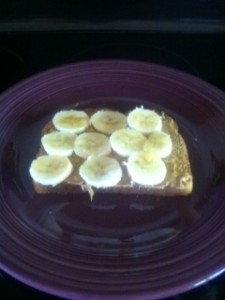
- Peanut butter or hummus on whole-wheat toast (my favorite! I included a picture of my favorite PB toast with bananas and honey)
- Breakfast quesadilla with low-fat cream cheese and sliced fruit
- Breakfast burrito or taco
- Toasted whole-wheat English muffin with lean ham and low-fat cheese
- Toasted pita with scrambled egg and low-fat cheese
- Low-fat milk and 100% fruit
If you are one who is not a fan of breakfast but understands the importance of it, I encourage you to try a variety of these options and see which one works best for you. I also encourage you to plan ahead. You may need to wake up 5 minutes earlier to fit breakfast in or make your smoothie the night before so all you have to do it pull the bottle or container out of the freezer or fridge in the morning and drink it on your way to work. Starting your day with a full tank will provide long lasting benefits to you and your body!
-Kelsey
by kelsey | Jul 24, 2012 | Food, Heart Health, Wellness/Health
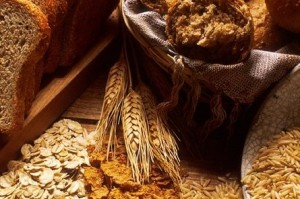
Lately, the farmers have been busy harvesting their grain crops such as oats and wheat. I always marvel at this process as what they’re doing is directly contributing to our food sources and availability. Without their hard work, our food chain would be greatly affected. Grains are an excellent source of energy for our brain and central nervous system. The whole grains are especially beneficial for promoting heart health due the fiber content. The average American only eats about 1 serving of whole grains a day and a serving is equivalent to a slice of bread, a cup of cereal, or a 1/2 cup of rice…which means that’s not much! We recommend at least half or your grain intake to be whole grains which should be at least 3 servings.
Whole grains are unrefined meaning they have all three parts still intact. Refined grains go through a process where the bran and germ are removed, thus extending shelf life and giving them a finer taste. Since the whole grains do not go through any processing and their germ (inner layer) and bran (outer layer) are still intact, they are a better source of fiber and other essential vitamins and minerals, especially selenium, potassium, and magnesium. When selecting a whole grain product, it’s important to look at the ingredient list and select a product that’s first ingredient is “whole” such as “whole grain,” “whole wheat,” etc. If the first ingredient says refined or enriched, that means that product is truly not whole grain.
Whole grains are found in brown and wild rice, whole wheat flour, oats, popcorn, rye, and whole wheat pasta. Like I’ve mentioned before, balance is truly key to a healthy diet, so achieving a balance of whole grains, lean proteins, fruits and vegetables will not only fuel your body but will aid in disease prevention. The fiber found in whole grains is not only beneficial for heart health, but also aids in stability for blood sugars, digestive health, and satiety. Next time you go to the store, make sure you take the extra few seconds to double check your label to ensure you’re getting a whole grain product…and be sure to thank our farmers for helping harvest our food supply!
-Kelsey
by kelsey | Jul 19, 2012 | Cooking Tips, Food, Weight Management, Wellness/Health

As I mentioned in my post yesterday, I am proud to be a part of South Dakota Team BEEF which is sponsored by the SD Beef Council. Team BEEF is a group of runners and health advocates who recognize the benefits nutritionally of lean beef and the important role this top notch protein can play in training. As members of Team BEEF, you get a running jersey to promote Team BEEF and reimbursement for several sponsored races. I first learned of Team BEEF from a good friend and fellow dietitian who helped start Wisconsin’s Team BEEF when she was in school there. As I learned more, I knew I had to get involved as I am truly passionate about health and wellness and am an advocate for lean beef protein. Yes, I may be little biased because I am the wife of a cattle rancher and that’s our way of living, however if you truly examine the research and evidence regarding beef protein, there truly is a place for it in our diets…as long as you are selecting the lean cuts the majority of time.
Did you know that beef is 20% leaner than it was about 15 years ago? There are at least 29 cuts of lean beef which means they meet the government guidelines for lean, meaning each cut has less than 10g of total fat, less than 4.5 g of saturated fat, and less than 95mg of cholesterol (in a 3 oz serving). Here are some tips for you to make beef a part of your heart healthy meals:
- Look for key words such as “round” or “loin” …these are typically leaner cuts
- Choose 90% or greater lean beef. This means in a 3oz serving there is less than 5g of fat in it.
- Use healthy cooking methods such as grilling, broiling, baking, roasting, or braising. The less tender cuts can be marinated in a tenderizing marinade such as salsa or light Italian dressing.
- Trim the fat! Trimming the fat before cooking will help eliminate some of the fat from the cut.
- Cook with fresh ingredients such as lemon juice, peppers, onions, garlic, and herbs instead of adding extra fat to the cut.
- Practice portion control. Select the 3-5 oz serving over the 10oz.
Balance is key to a healthy diet, so be sure to include your fruits and veggies and whole grains along with your lean meat to create a healthy plate. As of a just a few months ago, all meat is required to have the nutrition content (label) posted by it in the grocery store. Be sure to use this when you’re selecting your cuts of meat and pay special attention to the total fat and saturated fat content. If you want to learn more about the benefits of beef and explore healthy recipes check out these websites: www.beefnutrition.org and www.beefitswhatsfordinner.com.
Below is a picture of some of the SD Team BEEF members after the Beef & Eggs 5k.

-Kelsey
