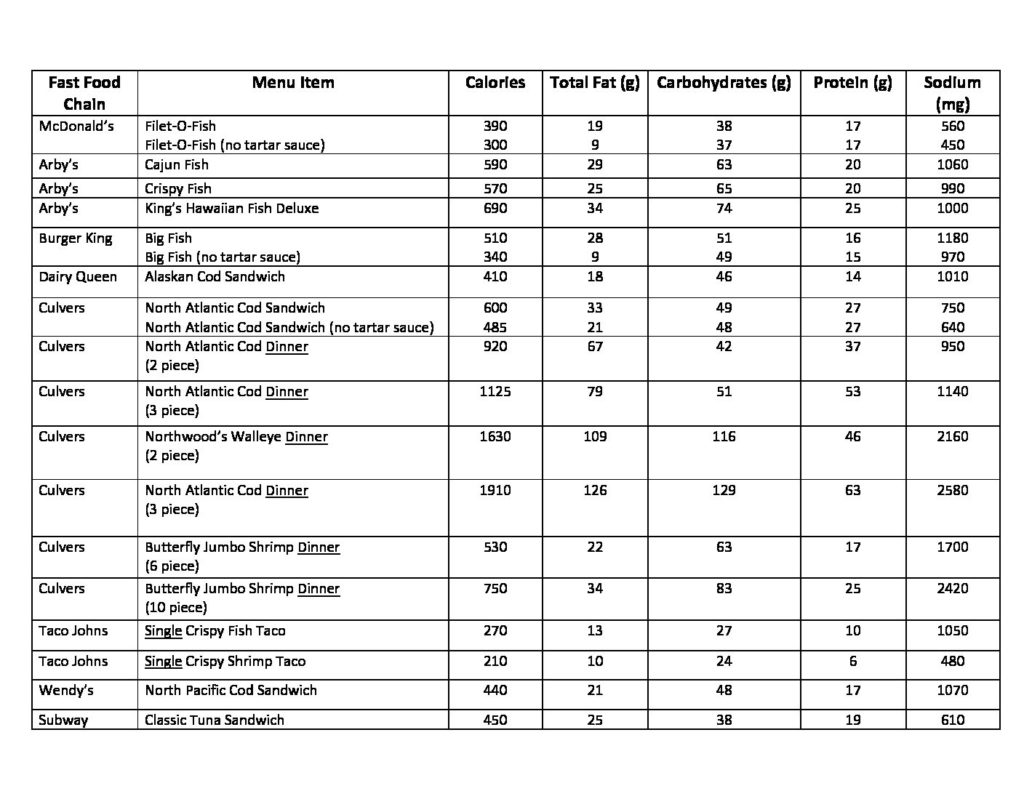
As many of you may have noticed, the fast food restaurants are beginning to add fish sandwiches and fish meals back to their menu for the lent season. Lent is a period of six weeks where Catholics abstain from meat on Ash Wednesday and every Friday until Easter. Therefore, determining what to make for lunch or supper that does not contain meat can be a challenge. This article will help you compare the different seafood options fast food restaurants offer and assist in small changes you can make to eliminate some of the excess calories and fat provided from these menu items. Fast food can be a convenient option when factoring in our busy lifestyles, however, being mindful of what we are putting into our bodies is also important. Many of the options offered provide almost half of your daily 2,000 calorie allowance or more. The table above provides an overview of the different seafood options fast food restaurants offer displaying the number of calories, fat, carbohydrates, protein, and sodium content of the menu items listed. When reading the nutrition facts for menu items above be aware that the totals for the sandwiches do not contain a side of fries unlike the dinners from Culvers, which include the sides in the totals. For example, the Filet-O-Fish sandwich from McDonalds provides 390 calories and the Culvers 2-piece North Walleye Dinner, which includes fries, coleslaw, and a dinner roll provides 1,630 calories. Therefore, choosing to go with the single sandwich and packing a fruit or vegetable to snack on would prevent you from eating most your calorie allowance in one meal. Condiments are used to improve and heighten flavor but they can add extra calories to the foods we are eating quicker than we expect. For example, the Burger King’s Big Fish provides a total of 510 calories, however, that does not include a side of fries or a drink. Ordering the Big Fish without tartar sauce or removing some of the extra sauce helps eliminate some of the extra calories and fat. For example, the Big Fish without tartar sauce provides a total of 340 calories, which is a difference of 170 calories. Condiments have been called danger foods due to the ‘hidden’ calories many individuals forget to account for when consuming a meal, therefore, being mindful of the amount placed on the foods we are eating is important. When deciding which fast food restaurant to visit you may attempt to choose the ‘most healthy option’ however, that is not always an easy decision. Subway has always been portrayed as a healthier fast food option especially when compared to McDonalds. However, when comparing a McDonald’s fish sandwich, which contains 390 calories, to the Subway tuna sandwich, which contains 450 calories, McDonald’s fish sandwich has less calories and fat than the sandwich provided at Subway. Therefore, being aware of all the options out there can help you make a better and more informed decision when choosing a place to feed yourself and your family. Overall, there is no great fast food option to choose all the time. However, making mindful decisions to not include the condiments, adding a side of fruit or salad instead of fries, or just eating the main entree can help eliminate empty calories. Other options for those that participate in the lent season may be to make a peanut butter and jelly sandwich, grilled cheese, cheese quesadilla, waffles, pancakes, eggs, cold cereal, canned tuna, or home cooked fish or shrimp.
Sarah and I just got back from a week get away in Jamaica, and boy was it perfect timing. Everybody is so sick of the snow and cold, that just having some warmth, sun, beach, and ocean was better than any prescription treatment I could think of. Time to relax on the beach, listen to the ocean, read some books (for fun!), take a nap, go eat, and then repeat! No time schedule. No pressure. Do whatever, whenever. Perfect break. And…no snow, or cold! Sarah and I each year go somewhere warm in the Winter just to have a break. By the time we come back, we hope that Winter will be ending soon. It does not look like Winter will end soon this year, but still made for a great break.
The ocean views were great, especially sunrise and sunset. It is very relaxing to just sit and listen to the ocean waves, and not wind with snow swirling! Sarah and I went for at least a couple mile walk everyday along the beach, including the last day when we had to leave mid morning to go home on Friday.
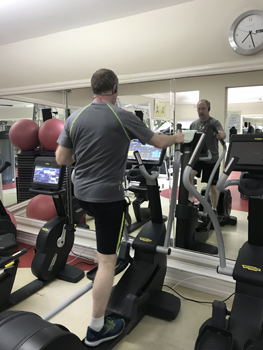
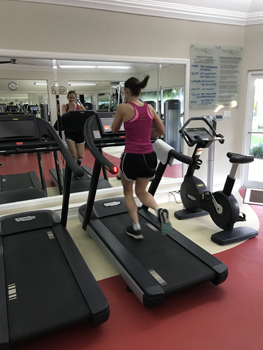
They had a fitness center on the resort we were at, and we hit that everyday too. I did not run, but was biking and using the elliptical, and Sarah would get her run in. I am going to ease back into this again!
I did see a great name for a boat while we were there!
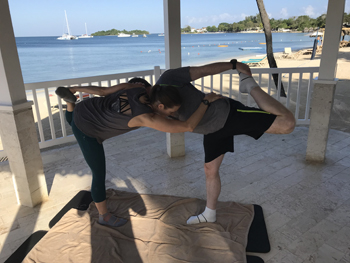
Some things just say it all. I am going to ease back into running again this week. I had a set back the last 2 weeks, and physical therapy has definitely been helping. I will resume that again this week. The rest of the exercise is just not the same when I can’t run. I have been having a really hard time trying to stay motivated. The weather is only making this worse. Everybody else is crabby because of the weather, but I think I am more crabby because I have not been running, and then the snow and cold just compounds it even more. My foot was doing pretty good with the walking, so time to start testing it again this week. Back to the pool again too! I sure hope by Spring when the weather does get better that I will be back outside on the road again running. I feel like I have been missing out on a lot this past 3 months or more. My daughter wrote in her blog this week that you really don’t know how much you miss something until you can’t do it. Right on! I have been struggling not being able to run more. At least I can do something to keep exercising, otherwise I would really be miserable! Sarah and I got in on the classes by the “fitness instructor” at the Sandals resort, Romario. He was a riot. He took this picture of Sarah and I doing our class on couples stretching along the beach. Who says exercising can’t be fun!
We are at least now into March. Even though we are hitting one of our coldest days this Winter with the wind chill again. This has to end soon, right? Stay positive, not only for yourself, but for others around you. After all, the saying goes: “What does not kill you makes you stronger!”. The only problem with this weather is it can kill you! Be careful. Stay active, just make adjustments and do it inside on some of the really bad weather days. Keep moving everybody!
Spring STRIVE 2 Survive, our 12 week wellness program, is set to start March 12th–that’s in 2 weeks!!!! Check out the details below and contact us today to reserve your spot! Email: strive2survive@brownclinic or Kelsey’s direct number: 884-4226.
STRIVE 2 Survive:
Over 20 years ago Dr. Dan Reiffenberger wrote a grant for the American College of Sports Medicine about the development of a fitness program entitled STRIVE to Survive. The STRIVE represents “Securing Time for Regular Involvement in a Variety of Exercise”. Since that time, it has become our Brown Clinic Wellness Program, with modifications and improvements along the way. It is a 12 week program incorporating exercise and nutrition, with the goal of continuing these types of habits for a lifetime. Our dietitian Kelsey Raml has helped incorporate the nutrition component and Dr. Clark Likness, Dr. Jon McAreavey, and Deidra Van Gilder, PharmD are also involved creating a multi-disciplinary approach to health and wellness.
We the 12 week program periodically throughout the year. During the 12 weeks, we meet every other Tuesday at the Park and Rec Fieldhouse from 5:30-6:30pm. During the weeks we don’t meet, each participant gets a take home lesson focused on our two main components: diet and exercise. The meetings are held in a group atmosphere, but we can also work with you individually in the clinic if desired.
12 Weeks to a Better You!
Brown’s Diet and Exercise Wellness Program.
Who:
– The Strive2Survive Wellness Program is open to everyone, young and old.
– Conducted by Dr. Dan Reiffenberger, Board Certified in both Family Medicine and Sports Medicine and Registered Dietitian Kelsey Raml.
What:
– Lose Weight- Gain Strength – Maintain Fitness- Improve Diet.
– Evaluations: lab work- lipid and glucose, body composition testing-weight, height, BMI, body fat mass and percent, muscle mass…all pre and post the 12 week program.
– Free T-shirt
– 6 class lectures and 6 take home lessons.
Where:
– Park & Rec Fieldhouse
When:
March 12: “Healthy Eating Made Easy” Kelsey Raml, MS, RD, LN
March 26: “Exercise for the Health of It” Dr. Dan Reiffenberger & Dr. Eric Woolley
April 9: “Your Equation to Success” Dr. Jon McAreavey
April 23: “A Walk thru the Wellness Wheel” Dr. Clark Likness
May 7: “Medications…to do or not to do” Deidra VanGilder, PharmD
May 21: “Making Health a Way of Life” STRIVE Team
Cost:
– $130
Call, e-mail or use the contact form for more information.
Kelsey Raml, MS, RD, LN
605-884-4226
strive2survive@brownclinic.org
STRIVE 2 Survive, our 12 week wellness program starts in about 3 weeks, March 12th!! We often have people ask about the results of the program as they try to decide if they should enroll or not. Today’s post is about results as I wanted to share some of the results we have seen: not only weight loss, but great improvements in lab work, BP, and waist circumference, which greatly impacts disease prevention and overall wellness. Below are a few of our participant’s results for you to see how beneficial the program can be! Enrollment is underway right now! Contact us today to get signed up for a better you! Email: strive2survive@brownclinic.org or 884-4226.
This winter we have had our share of snow and blizzard conditions. We are all tired of it and it just keeps coming! It can certainly wear a person out mentally and physically. When you’re feeling the blues, it can really get you down in the dumps which can result in overeating, less activity, and depression. I personally feel I suffer from a little bit of Seasonal Affective Disorder (SAD)but I have found there are a few things that spark my spirit so I hope they can help you as well!
Tips for Overcoming the Winter Blues
•Get active! Activity produces natural endorphins that boost mood. I was exercising already, but to help ward off the winter blues, I have increased the amount of exercise and added some strength training to my routine. Try getting at least 30 minutes of activity in a day…if you can do more, the better.
•Eat Right: healthy eating will make you feel healthier inside and out. Aim to get at least 5 fruits and veggies a day, include whole grains, lean meats, and healthy fats. Vitamin D has been proven to aid in SAD so be sure to get your 3 servings of low fat milk or dairy products. If you aren’t a milk drinker you may consider taking a daily multivitamin with calcium and vitamin D or a vitamin D supplement. Please ask your dietitian, pharmacist, or doctor for the correct dosage.
•Spice up your life: Sometimes getting a new shirt, going to the movies, reading a new and exciting book, or getting new tunes on your ipod will help spice up your life and add some more excitement to your life.
•Get out! Plan a family/friend trip to somewhere close or even tropical, bum around downtown Watertown, or plain just get out of the house! It’s easy to dwell in our sorrows by becoming a hermit and staying inside. We need to get out and get some socialization!
•Think Positive! Dwelling on the negatives can sure take a person down. Instead think about the positives in your life and the upcoming holidays. Tell yourself one positive thing about yourself and your selfworth daily. Focus on the blessings in your life!
•If you feel you are suffering from the blues very seriously then I encourage you to contact your physician for further assistance as we can help you with this!
Stay positive, eat right, exercise, and get out…those winter blues will be gone before you know it and spring will be here soon!