by kelsey | Aug 26, 2014 | Cooking Tips, Diet, Weight Management, Wellness/Health

With everyone getting back into the groove of school this week, it means children are going back to the cafeteria. The importance of talking with your children about nutrition is crucial to their health. Children need to be able to make healthy decisions on their own. There are several steps a parent can make when helping their child go back to school.
Look over the menu: Review the weekly or monthly school menus with your child and decide which meals they like and dislike. For the days your child decides to eat at school help them distinguish the healthier choice, like choosing fruit instead of a cookie. Studies have shown letting your child help in the decision-making process makes them more likely to follow through with the decision.
Packing your own lunch: Make sure you’re packing meals with enough nutrients to power your child through the rest of their school day. Let your child be a part of the lunch packing process whether if it is making the sandwich or packing fruits into a bag. Pack food your child likes, because if they don’t eat it at home they are not likely to eat them when you’re not around.
Follow up at home: Make sure to follow up their lunch with an equally healthy dinner. Having a well balance meal at every meal is very important. A child who eats healthy at home is more likely to make healthier choices when they are on their own.
Tips for Packing Healthy School Lunches:
- Plastic bags and containers will really help with portions while making a sack lunch.
- Keep in mind that they will not be eating right away and to keep the refrigerated foods cool to keep from spoiling. For example, dairy products such as yogurt, will need a cool pack.
- Pack the lunch the night before with leftovers from dinner to save time in the morning.
- Make sure to include the child while making lunch and give them healthy choices to choose from.
- Try to choose less sugary drinks, like skim milk instead of chocolate milk or crystal light instead of a high sugar juice.
Keeping the lunches safe by keeping all the food at the correct temperatures. Pack cold items in an insulated lunch box with a frozen pack. Keep warm soups in a thermos, make sure the thermos is clean and use very hot water.
Sandwich Ideas
Whole wheat bread with deli meat (try to avoid bologna, pepperoni, and salami)
Peanut butter and jelly sandwich
Bagel with cream cheese or peanut butter
Crackers and cheese
Pita with hummus
Ham and cheese rolled up in a whole wheat tor-tilla
Crackers and cheese
-Kelsey
by kelsey | Aug 20, 2014 | Diet, Exercise, Goals, Heart Health, Motivation, Weight Management, Wellness/Health

It’s hard to believe school is back in session and fall is approaching quickly. We are always sad to see summer go as it seems to fly by faster every year, but I am excited for my favorite season (fall) to get here and to start another session of STRIVE 2 Survive! I always like to highlight a few of our success stories and previous participants to show what STRIVE can do for you! Laurie Danforth and her husband Mike participated in STRIVE 2 Survive and found great value in it. If you are on the fence or wondering if you should join us, check out Laurie’s feedback below. We hope you will consider it and let us help you improve your health and well-being through improved nutrition and activity! If you have any questions or want to learn more, please email us at strive2survive@brownclinic.org or call 884-4226. Fall STRIVE starts September 16th!
- What pushed you to join STRIVE? After sending our last child off to college and becoming empty nesters we decided it was time to change our eating habits. Mike wanted to lose a few pounds so I suggested we do S2S and do it the right way.
- What was your goal? (weight loss, cholesterol, B/P, healthy eating, etc.) My goal was to develop better healthy eating and to maintain of improve lab values.
- Have you met your goal? Yes until the kids came home for the summer then our eating changes some but I always have S2S on my mind and look for healthier ways to fix meals.
- If so, what are you doing to maintain? Looking forward to 2 of the boys returning to college to help with our change of habits when had adapted to.
- How did STRIVE help? Brought awareness to foods and their contents and also the ability to prepare foods differently to make them healthier. The frequent e mails and updates on the web also help.
- What is your motivation to continue? My competitiveness to keep my lab values where they were after being diligent of changing habits. I challenge myself to make sure they stay in good healthy ranges. I also feel much better after changing my diet habits.
- If you could tell anyone about Strive to Survive, what would you say? By all means join the program. Don’t think of it as a “diet” but a way of changing your daily eating habits along with exercise. It is not all about weight loss but eating healthier and making changes to adding or increasing exercise. I lost inches and improved lab values but did not lose much weight, all with feeling better. (Side note–Laurie didn’t have much to lose, so she focused on toning, lab improvement, and overall health improvements)
- Do you feel that the program has a lifetime change for you? By all means.
- What do you think they biggest highlight of the program is? Learning how to label read and prepare foods bought at the grocery store to change habits. It is much cheaper and healthier to buy foods at the grocery store for weight loss versus buying a program of mixes and shakes that may produce rapid weight loss. I know with this program I was making healthy choices that were not inadvertently affecting my lab values.
- Would you tell a friend about us? I have told friends about this program and encouraged them to join. The cost of the program is far less than “buying” weight loss with the many advertised programs out there.
- If people are in doubt of joining, what would you tell them? Give it a try!
-Kelsey
by kelsey | Aug 5, 2014 | Cooking Tips, Diabetes, Diet, Eating Out, Food, Weight Management

As I discussed last week, eating out can be a challenge as you aren’t sure how the foods are prepared, what types of foods are used, and what the food prep consists of. You may question, are the healthier looking choices sometimes worse for you? A salad over a hamburger should always be healthier, right? We find that in some scenarios this is not the case at all. Because of added seasoning, dressing, and breading the choices that appear to be healthier can have more calories. A way to avoid some of these unnecessary calories is to ask for the dressing on the side, or ask for your meats grilled instead of fried. If you eat at a restaurant regularly it’s not a bad idea to look at their menu online for their nutritional values. This could help you make a healthier decision when going out to eat. In addition, you may also consider using a pocket guide book such as Calorie King’s book (www.calorieking.com) or using an app on your smart phone. Besides making a good choices, portion control is essential! Take half of your meal home or share with a friend or family member. That alone will cut down on calories, fat, and sodium.
Here is a fun quiz to help you compare some foods and see which have more calories. The results may surprise you.
1) Applebee’s Oriental Chicken Salad (with dressing) Vs. Applebee’s Bacon Cheeseburger
2) McDonalds the Big Breakfast with Hotcakes Vs. McDonalds Angus Delight
3) McDonalds Cheeseburger Vs. McDonalds Chocolate Shake
4) Culvers Fresh Fried Chicken Dinner Vs. Culvers Chicken Sandwich Value Basket
5) Arby’s Medium Curly Fries Vs. Arby’s Pecan Chicken Salad Sandwich
********************************************************************
Answer #1 The Bacon Cheeseburger has fewer calories at 970 calories compared to the Oriental Chicken Salad that has 1390 calories.
Answer #2 The Angus Delight has fewer calories at 750 compared to the Big Breakfast with Hotcakes that has 1090 calories.
Answer #3 The Cheeseburger has 300 calories compared to a Chocolate Shake that has 570 calories.
Answer #4 The Chicken Sandwich Value Basket is 422 calories compared to the Fresh Fried Chicken Dinner that has 2220 calories.
Answer #5 The Curly Fries are 540 calories compared to the Pecan Chicken Salad Sandwich that has 840 calories
-Kelsey
by kelsey | Jul 30, 2014 | Cooking Tips, Diabetes, Diet, Eating Out, Food, Weight Management, Wellness/Health

Everyone is busy and on the run with life happenings so eating out tends to be a part of our lives. We all know that eating out is not the best for us as we don’t have control over how the meal is prepared, ingredients, and portions like we do at home. Despite this, we all still eat out and most of us enjoy it as it means we don’t have to do the preparing, cooking, and cleaning up afterwards…and it’s typically a social activity as well! Restaurants are taking notice of our nation’s desire to improve our health and wellness and there are more healthier options on the menus today, but there are still some very unhealthy ones as well. Below are some tips to help you eat out the healthy way:
- Go for a smaller portion of the meal such as half of the meal, lunch portion, or appetizer size portion.
- Look for key words such as baked, broiled, grilled, or roasted. Stay away from descriptive words such as crispy, creamy, crunchy, and crispy as those typically mean fried and more fat added.
- Substitute the fries for a salad (dressing on the side and use sparingly) or if available a second serving of cooked veggies or fruit.
- Get a to-go box right away before you start eating and package half of your meal in the box and eat at another meal at home. If it’s on your plate, you’ll be more apt to eat it, so put it away right away so you aren’t tempted and you are more apt to practice proper portion control.
- Share! It’s ok to share an entree with you friend, spouse, etc to help you practice better portion control.
- Look at the options ahead of time online or using your smart phone. Many restaurants have their nutrition information included in their websites or you can use the Calorie King app to explore the options and make a healthy choice when dining out.
- If eating out is a rare occurrence, it is ok to splurge, but keep in mind it should be a special occasion and only every once in awhile, not every day or every week as those extra calories will add up and cause weight gain quickly!
- To help balance out the extra calories consumed when eating out, be sure to get your activity in and engage in at least 30-60 minutes/day!
-Kelsey
by kelsey | Jul 24, 2014 | Diabetes, Diet, Food, Heart Health, Weight Management, Wellness/Health

I often get asked about meal replacements such as Boost, Atkins, Slim Fast, Ideal Protein, etc. Are they good? Should I use them? What kind? etc…
The Academy of Nutrition and Dietetics does approve the use of meal replacements for weight loss efforts: “Several studies comparing isocaloric diets have shown an equivalent or greater weight loss efficacy with structured meal replacement plans, compared to reduced calorie diet treatments. One or two daily vitamin- and mineral-fortified meal replacements, supplemented with self-selected meals and snacks, may be a successful weight loss and weight maintenance strategy for overweight and obese adults who have difficulty with self-selection of food and portion control.” (http://www.andeal.org/topic.cfm?cat=2886&conclusion_statement_id=250237&highlight=meal%20replacements&home=1).
The key words are one or two replacements/day, not your whole day and paired up with a well-balanced, calorie reduced diet. I typically recommend the use of these for the meal when the individual is on the run the most. Sometimes you are rushed in the morning to get to work or school and don’t have time for breakfast, in this case, a meal replacement may be a good idea…or maybe it’s lunch as you only get a short break and a meal replacement might fit in well here. The biggest thing to remember is you are drinking your meal, not eating it. Some people are truly satisfied this way and others are not. Personally, I do not use meal replacements because I know I need to “eat” my food to be satisfied rather than “drink” them…when I drink something, I feel like I still need to eat thus a meal replacement would only add more calories! Another reason why I don’t do meal replacements is I prefer real food. I would rather eat whole food than drink a supplement….but that’s just me. 🙂 One more thing to consider is they are typically around 150-200 calories. This may not be enough for a meal, so you may consider adding a piece of fruit, salad, or yogurt to it to give you a little more substance.
Meal replacements do have a place in our society for helping people manage their weight, but there are many kinds so it’s important to check out the ingredients, nutrients, and prices. If you notice a really long ingredient list, there is more “stuff” added to the product and then you need to consider if you really need all of that extra “stuff.” Some ingredients can affect your body in certain ways, so you may need to check with your physician, pharmacist, or dietitian to ensure it is safe to consume. Costs also makes a difference. You have to remember that these companies are trying to make money off of you, so consider cost and value when you make your selection. In addition, it’s important to consider that a well balanced, portion controlled, healthy meal of real food can be cheaper than some supplement drinks! Below is a chart Alex Loes, SDSU Dietetic Student made for me to compare the various choices. I hope this helps you, but if you have any specific questions regarding choices, selections, or even disease states and the use of these, don’t hesitate to contact me. I’m here to help you as your credible and reliable nutrition information source!
-Kelsey Raml, MS, RD, LN
| Brand (oz/serving) |
Price/oz |
Calories |
Protein (g) |
Carbohydrates (g) |
Fiber (g) |
| Boost Calorie Smart (8) |
0.20 |
190 |
16 |
16 |
4 |
| SlimFast (10) |
0.11 |
190 |
10 |
29 |
5 |
| Shakeology (12) |
0.36 |
160 |
17 |
17 |
6 |
| Atkins (11) |
0.17 |
160 |
15 |
5 |
3 |
| Special K (10) |
0.14 |
190 |
10 |
29 |
5 |
| Ideal Protein (10) |
0.40 |
210 |
26 |
14 |
5 |
| Advocare (9) |
0.36 |
220 |
24 |
24 |
5 |
| Sanford Profile (9-12) |
0.25 |
100 |
15 |
7 |
0 |
by kelsey | Jul 23, 2014 | Diabetes, Diet, Exercise, Food, Heart Health, Weight Management, Wellness/Health
With as long as our winters last, I certainly do not want to complain about the hot temperatures, but I do want you all to practice proper procedures to ensure you do not suffer from any heat related illnesses such as heat stroke or dehydration. With the high temps and humidity, it’s extra important to make sure you get enough fluids! It is important to stay hydrated throughout the day, as it is too late, if you wait to get a drink when you feel thirsty. Especially for those older adults, it takes longer for them to feel thirsty even though they may be severely dehydrated.
Tips for getting adequate fluids:
- Keep a glass or bottle of water with you during the day so you can sip on it. Drink when you are thirsty and even when you are not thirsty.
- Drink more water instead of sugary beverages, milk and juice to avoid those extra hidden calories. Alcohol will increase your water loss. Plain water always works the best.
- Increase your fluid intakes if your diet is high in fiber, protein or salt.
- On days where you may be sweating alot or burning extra calories such as an all day softball tournament in 80-90 degree weather, or doing yardwork/landscaping in the heat all day…you may need to add electrolytes such as Gatorade or Powerade. I prefer G2 Gatorade as it’s lower in sugar, yet still has plenty of electrolytes. **Please note, these drinks are not necessary when you’re doing less than an hour of light activity or more sedentary activities as they just add extra calories and sugar.
- Consult with your doctor or dietitian if you are on a fluid restricted diet and would like further help with your hydration needs.
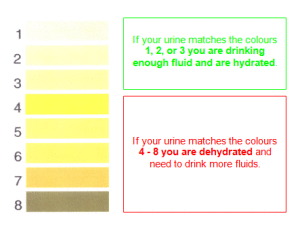
Use the above chart to determine your hydration level by the color of your urine.
-Kelsey
Graphic Reference:http://www.brownsburgathletics.com/images/urine.gif

