by kelsey | Jul 18, 2013 | Cooking Tips, Diet, Food

Today, the Brown Clinic Physicians treated us to a picnic! It was a delicious meal and a fun time with co-workers! Dr. Dan, Dr. Cathy Gerrish, Dr. Ed Gerrish, and Dr. Larson are shown in the picture as they helped dish everyone’s plates up. Since today was really hot, we took extra precaution to ensure the food was kept safe and everyone stayed cool under canopies and tents outside. Outside picnics on hot days like today can really put your food at risk for development of bacteria due to the extreme heat. Since we have plenty of summer left to have many more picnics, I wanted to give you some tips on ways to avoid any foodborne illness from occurring.
1) Wash your hands! Take a few minutes before prepping, during food prep, and serving to thoroughly wash your hands. It is recommended to wash your hands for at least 30 seconds and be sure to get in between the fingers and around the nails. Hand sanitizer does not replace hand washing so if you are camping, be sure to bring a bucket of water and soap for hand washing. It is especially important to wash your hands after handling raw meat and in between handling other food sources such as vegetables to prevent cross contamination.
2) Wash your produce before the picnic: if you are going to be camping and running water is not readily accessible, wash your produce before leaving home. It’s especially important to wash the outsides of melons before cutting them as if there is bacteria on the outside, you will contaminate the whole melon as you cut your knife through. Package raw meats appropriately to ensure the juices do not leak on other foods.
3) Keep your cooler cool: keep plenty of ice in the cooler to ensure your foods are kept cold. Cold foods should be kept under 40 degrees F…so on hot days like today, it’s especially important to have plenty of ice and keep the cooler in the shade vs direct sunlight and heat. Packing your beverages in a separate cooler is also a good idea so that you can ensure your food items are fully kept cool.
4) Beware of the “Danger Zone”: The Danger Zone refers to the temps between 40-140 degrees F where bacteria can easily grow and reproduce. Keep your cold foods cool and your hot foods hot. Don’t let food sit out for more than 2 hours at a time and if it’s over 90 degrees, food can only sit out for 1 hour. Keep salads such as potato salad, etc under a bowl of ice to provide for extra cooling.
5) Use proper utensils and don’t cross contaminate: use separate plates and utensils for handling raw meat and the cooked meat. Do not put the cooked meat on the same plate you had the raw meat as this will contaminate your cooked food. In addition, use separate serving dishes, cutting boards, utensils, etc for your dishes…thus do not use the same cutting board for dicing your meat, cutting up your lettuce, and preparing your fruit salad!
6) Use a thermometer: by using a thermometer to check the temps of your foods in the cooler, when they’re cooked, etc, it will help prevent foodborne illness!
-Kelsey
by kelsey | Jul 16, 2013 | Diet, Exercise, Food, Weight Management, Wellness/Health

Like Dr. Dan, my Saturday included friends and fitness as well as I participated in the Beef & Eggs 5k along with many other South Dakota Team BEEF members and friends! “Team BEEF is a community of runners and health enthusiasts who recognize the nutrition benefits of lean beef and the vital role this high-quality protein plays in their training.” (http://www.sdbeef.org/teambeef.aspx). The Beef & Eggs 5k was one of our sponsored races this year and SD Team BEEF was well represented! It’s a great opportunity to do two things I love: exercise and promote the benefits of lean beef. Red meat tends to get a bad rap, but in reality, it’s an excellent source of protein and if you choose the lean cuts (there are 29!), it can truly be a part of a healthy and balanced diet.
Did you know that beef is 20% leaner than it was about 15 years ago? There are at least 29 cuts of lean beef which means they meet the government guidelines for lean, meaning each cut has less than 10g of total fat, less than 4.5 g of saturated fat, and less than 95mg of cholesterol (in a 3 oz serving). Here are some tips for you to make beef a part of your heart healthy meals:
- Look for key words such as “round” or “loin” …these are typically leaner cuts
- Choose 90% or greater lean beef. This means in a 3oz serving there is less than 5g of fat in it.
- Use healthy cooking methods such as grilling, broiling, baking, roasting, or braising. The less tender cuts can be marinated in a tenderizing marinade such as salsa or light Italian dressing.
- Trim the fat! Trimming the fat before cooking will help eliminate some of the fat from the cut.
- Cook with fresh ingredients such as lemon juice, peppers, onions, garlic, and herbs instead of adding extra fat to the cut.
- Practice portion control. Select the 3-5 oz serving over the 10oz.
Balance is key to a healthy diet, so be sure to include your fruits and veggies and whole grains along with your lean meat to create a healthy plate. As of a just a few months ago, all meat is required to have the nutrition content (label) posted by it in the grocery store. Be sure to use this when you’re selecting your cuts of meat and pay special attention to the total fat and saturated fat content. If you want to learn more about the benefits of beef and explore healthy recipes check out these websites: www.beefnutrition.org and www.beefitswhatsfordinner.com.
It was a hot and humid morning for a run (hence the red faces in the pictures!), but we had a blast together. My brother-in-law asked me why we chose to run 3 miles “for fun”…yes, it may sound weird that my friends and I met in Brookings to run together, but having something like this on my calendar keeps me motivated and helps me meet my fitness goals. Exercise has always been a part of my friendship with these girls as some of us competed on the SDSU equestrian team together, so it’s natural to run together! I also talked my co-worker and friend Lacey into running another 5k with me! Having some activities like this planned into your schedule is a good way to keep you on track with meeting your fitness goals and helping you stay fit. Don’t be afraid to try a fun run or 5k! There are all levels of runners and walkers!

-Kelsey
by kelsey | Jun 18, 2013 | Diet, Family, Food, Holidays, Weight Management, Wellness/Health
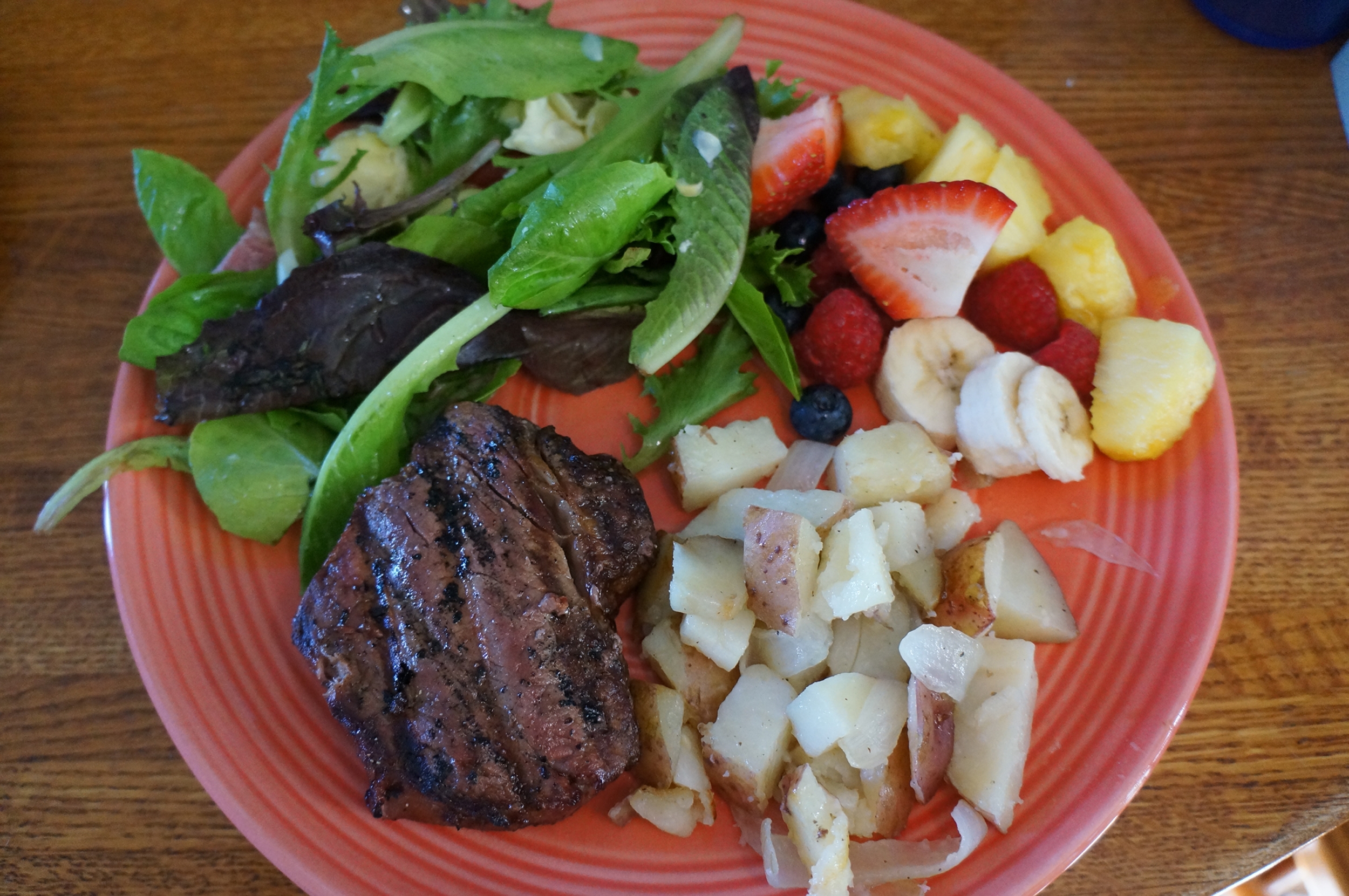
This last weekend, my family had a great Father’s Day celebration all weekend complete with boating, fishing, good food, campfires, and fellowship. My brother Lincoln and his family came from Wisconsin and it’s always a treat to get to be with their two little girls. We had an awesome supper Saturday night to celebrate the great dads and I have to say I was quite proud of our family! We grilled our own Raml Cattle lean steaks, had potatoes on the grills, and a bunch of really great fruits and veggies. As I dished up my plate, I noticed it mirrored the USDA’s MyPlate’s icon and I couldn’t resist taking a picture of it! I think it’s very important to practice what you preach and if I am giving you recommendations on healthy eating, I feel it’s essential for me to practice those recommendations as well! This meal was fairly simple to prepare and was thoroughly enjoyed without the feeling of being too full. Things to have on hand to make a healthy plate include: lean proteins (in this case we used sirloin), plenty of fruits and veggies to complete half of your plate, and a quarter starch or grains (we grilled red potatoes with a little olive oil). When you eat a balanced, portion controlled plate like this, you will feel content and the need to snack and over-eat is greatly decreased. I hope all of you Fathers out there enjoyed your day and got extra special treatment! I know I sure enjoyed the weekend with my family as we celebrated!

My Dad helping me grill.

“BEEF, it’s what’s for dinner.” Our delicious Raml Cattle steaks were perfect for our Father’s Day celebration!
-Kelsey
by kelsey | Jun 12, 2013 | Diet, Weight Management, Wellness/Health
Wouldn’t it be awesome if there was this magical pill that helped us lose weight and we didn’t have to make any efforts to get it to work!?! Dr. Oz advertises many products that claim to aid in weight loss and there are uncountable fad diets out there….which keeps us dietitians on our toes as we constantly are educating and de-bunking the myths of these programs and products. Between raspberry ketones, green coffee bean, etc, etc etc, we often wonder if there really is a magical pill. Despite the desire for this, the fact of the matter is that there is no such thing and there never will be! Healthy weight loss and weight maintenance do require effort, hard work, dedication, and motivation…and it takes time to change our lifestyle, behaviors, and choices so it will take time for that weight to come off and stay off. You didn’t put it on in one day so don’t expect to lose it one day! It not only requires you to examine the choices you’re making, but it’s also essential for you to take a closer look at your consistency of intake (or lack there of) and your behaviors and emotions about food. Looking at the big picture will help you be mores successful in the long run and help you avoid that trap of yo-yo dieting and negative feelings towards food and yourself. Next time you hear a claim about a product or program, consider a few things: is it safe?…has it been tested or approved by credible agencies? ….what is the population of the people who trialed it? (small studies are not credible or reliable)…..does it sound too good to be true? ….do you cut out several food groups? …..is exercise NOT advised? If you answered yes to any of these questions, it’s most likely too good to be true. Stay focused and be patient, you really can do this and be successful at it by working on improving your lifestyle and behaviors one at a time. Positive thinking and determination will help you be successful!
-Kelsey
by kelsey | Jun 11, 2013 | Diet, Food, Wellness/Health
GMOs or Genetically Modified Organisms have been in the news frequently and the discussion continues to increase as states consider labeling laws. As a Registered Dietitian and supporter of agriculture, I feel it’s important for you, as consumers, to understand the facts. Understanding the facts and looking at evidence based studies and research is essential with this topic as you will find all kinds of crazy claims and stories by doing a quick Google search of which many of them are not credible and biased.
First off, it’s important for you to understand what a GMO is. Genetic engineering is used to describe methods used by scientists to introduce new traits or characteristics to an organism. For example, a food crop may be genetically engineered to enhance group or nutritional value of the food. People have been modifying plants for thousands of years through breeding and selection, however the term genetically engineered has been used to distinguish those plants that have been modified using modern biotechnology from those those modified through traditional breeding. GMOs have been around for over 20 years and are regulated by several government agencies. The FDA regulates food from GE (genetically engineered) crops along with the USDA (US Department of Agriculture) and the EPA (Environmental Protection Agency). Due to the multi-agency regulation and examination, there has been thorough review on these products and practices to ensure their safety. In the history of using and consuming GE foods, there have been no harmful reactions or effects in humans.
Putting it simple: GMOs are effectively used as a way to improve the control of pests, weeds, plant diseases and increase their tolerance to drought and flood. This helps decrease the use of herbicides, reduce tillage & soil erosion, decreases insect infestations and increases yield. By the year 2050, the world’s population is expected to reach 9 billion. Currently, 3.5 million children under the age of 5 die every year as a result of undernutrition. GM foods have been developed to decrease world hunger and malnutrition. For example, scientists have developed rice with increased levels of beta-carotene. This rice is used to feed regions of the world which are deficient in vitamin A. GMOs are also being used to increase the amount of ethanol which can be produced from corn, therefore, reducing our dependence on foreign oil. Using GMOs in farming is the only way for farmers to feed the hungry world.
There some states considering a labeling law for these products. I do believe consumers have the right to know what’s in our food, however I want you to know and understand that GMOs are proven safe and that there truly is a purpose for them in our food system, so this shouldn’t straw you away from eating them or raise concerns. If you are concerned about GMOs you may consider eating organic. Personally, I feel eating organic is a personal preference and that there are just as much concerns about food safety with organic foods since they do not use pesticides, etc to kill the natural bacteria and many foodborne outbreaks are the result of organic farming practices.
So all in all, I feel it’s important for you to understand the use and science behind the use of GMOs and to use credible sources such as the FDA, USDA, EPA and unbiased university studies for education and knowledge. It’s essential to look at the evidence based facts before you form an opinion. We are all entitled to our own opinions, however I do hope this will help you understand the benefits of GMOs, despite whatever your opinion is.
From a personal insight, all the crops we (my husband and family) plant are GMOs as is the only way we can help feed the hungry world. Our beef is not organic, but our cows are well cared for and taken care of, thus providing us and you as consumers, a quality and safe product to consume. I do not eat organic, but I do practice proper food safety and strive for a balanced intake. You have heard me say it before, but moderation and balance are essential to healthy eating!
-Kelsey
Reference: http://www.fda.gov/ForConsumers/ConsumerUpdates/ucm352067.htm
by kelsey | Jun 6, 2013 | Diet, Food, Weight Management, Wellness/Health
June is National Dairy Month so I decided today would be a good day to discuss the benefits of dairy…and let me tell you, there are many!! Cow’s milk is the richest source of well-absorbed calcium and is actually absorbed better (about 25%) than the calcium in soy milk. There is about 300 mg of calcium in an 8 oz serving of milk and we recommend getting at least 3 servings of dairy a day. A serving is equal to an 8oz (1 cup) serving of milk, 6 oz tub of yogurt, 1 oz cheese, 1/2 c cottage cheese. In addition to calcium, cow’s milk is an excellent source of phosphorus, vitamin B12, potassium, riboflavin, vitamin A, vitamin D, protein, and niacin…totalling 9 nutrients compared to only 4-5 nutrients found in soy and almond milk.
There are many other types of “milks” out there such as almond, rice, coconut, and soy, however these drinks are not the same as cow’s milk in regards to the nutritional qualities. Many of these milks use fortification (adding nutrients), whereas the nutrients are found naturally in cow’s milk. Below is a list from the Midwest Dairy Association about these beverage’s nutrient sources and nutrition quality (http://www.midwestdairy.com/0p335/dairy-imitators/)
- “Soy beverages are made from soybeans and are a good source of protein. However, according to the Protein Digestibility Corrected Amino Acid Score (PDCAAS), soy protein is a lower quality protein than the whey protein found in dairy products.
- Rice-based beverages are generally processed from brown rice and are fortified with nutrients such as calcium and vitamin D. Rice beverages typically contain only one gram of protein compared to eight grams in cow’s milk.
- Nut-based beverages can be ground from any nut and the most popular is almond. Almond beverages only supply one gram of protein per serving and lack many of the natural benefits found in almonds.
- Seed-based beverages, such as hemp, are newer to the marketplace. Their nutritional benefit is touted to be their omega fatty acid content. Similar to the other beverages, they also fall short on protein.”
Often times, these other “milks” contain higher sugar content, less calcium, less protein, and are absorbed less than those benefits in cow’s milk. Now if you have a lactose intolerance or milk allergy, these are certainly options for you, however if you do not have an allergy or intolerance, I highly encourage you to work towards getting your 3 a day servings of dairy and preferably low fat dairy. It will not only provide you with excellent vitamins and minerals to keep your bones and muscles healthy and strong, it will also provide you with an excellent source of protein.
For more information on the benefits of dairy, you can visit www.midwestdairy.com or contact my good friend and fellow Registered Dietitian Whitney Jerman at wjerman@midwestdairy.com.
I know I will enjoy a nice glass of cold milk tonight with supper, I hope you do too!
-Kelsey
