by kelsey | May 25, 2016 | Diet, Food, Weight Management, Wellness/Health
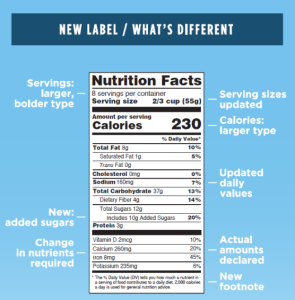
There is exciting news in the nutrition world this week! We are getting a new and improved nutrition label! The FDA revealed what the new label will look like and the changes are going to be very beneficial to us consumers! Here’s the scoop according to the FDA: http://www.fda.gov/Food/GuidanceRegulation/GuidanceDocumentsRegulatoryInformation/LabelingNutrition/ucm385663.htm
“Highlights of the Final Nutrition Facts Label
1. Features a Refreshed Design
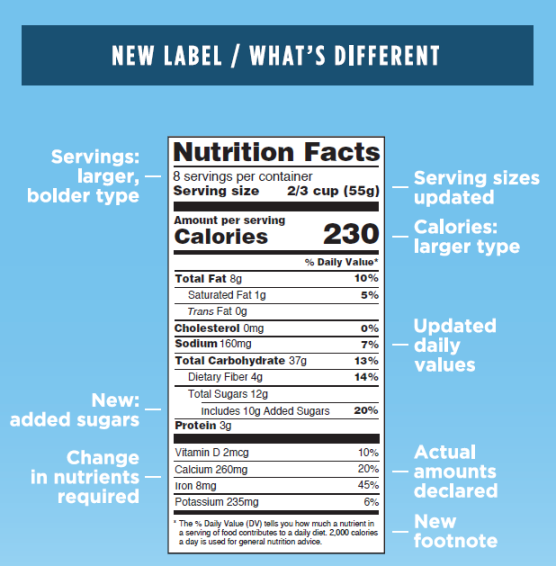
- The “iconic” look of the label remains, but we are making important updates to ensure consumers have access to the information they need to make informed decisions about the foods they eat. These changes include increasing the type size for “Calories,” “servings per container,” and the “Serving size” declaration, and bolding the number of calories and the “Serving size” declaration to highlight this information.
- Manufacturers must declare the actual amount, in addition to percent Daily Value of vitamin D, calcium, iron and potassium. They can voluntarily declare the gram amount for other vitamins and minerals.
- The footnote is changing to better explain what percent Daily Value means. It will read: “*The % Daily Value tells you how much a nutrient in a serving of food contributes to a daily diet. 2,000 calories a day is used for general nutrition advice.”
2. Reflects Updated Information about Nutrition Science
- “Added sugars,” in grams and as percent Daily Value, will be included on the label. Scientific data shows that it is difficult to meet nutrient needs while staying within calorie limits if you consume more than 10 percent of your total daily calories from added sugar, and this is consistent with the 2015-2020 Dietary Guidelines for Americans.
- The list of nutrients that are required or permitted to be declared is being updated. Vitamin D and potassium will be required on the label. Calcium and iron will continue to be required. Vitamins A and C will no longer be required but can be included on a voluntary basis.
- While continuing to require “Total Fat,” “Saturated Fat,” and “Trans Fat” on the label, “Calories from Fat” is being removed because research shows the type of fat is more important than the amount.
- Daily values for nutrients like sodium, dietary fiber and vitamin D are being updated based on newer scientific evidence from the Institute of Medicine and other reports such as the 2015 Dietary Guidelines Advisory Committee Report, which was used in developing the 2015-2020 Dietary Guidelines for Americans. Daily values are reference amounts of nutrients to consume or not to exceed and are used to calculate the percent Daily Value (% DV) that manufacturers include on the label. The %DV helps consumers understand the nutrition information in the context of a total daily diet.
3. Updates Serving Sizes and Labeling Requirements for Certain Package Sizes
- By law, serving sizes must be based on amounts of foods and beverages that people are actually eating, not what they should be eating. How much people eat and drink has changed since the previous serving size requirements were published in 1993. For example, the reference amount used to set a serving of ice cream was previously ½ cup but is changing to ⅔ cup. The reference amount used to set a serving of soda is changing from 8 ounces to 12 ounces.
- Package size affects what people eat. So for packages that are between one and two servings, such as a 20 ounce soda or a 15-ounce can of soup, the calories and other nutrients will be required to be labeled as one serving because people typically consume it in one sitting.
- For certain products that are larger than a single serving but that could be consumed in one sitting or multiple sittings, manufacturers will have to provide “dual column” labels to indicate the amount of calories and nutrients on both a “per serving” and “per package”/“per unit” basis. Examples would be a 24-ounce bottle of soda or a pint of ice cream. With dual-column labels available, people will be able to easily understand how many calories and nutrients they are getting if they eat or drink the entire package/unit at one time.
Compliance Dates
Manufacturers will need to use the new label by July 26, 2018. However, manufacturers with less than $10 million in annual food sales will have an additional year to comply.”
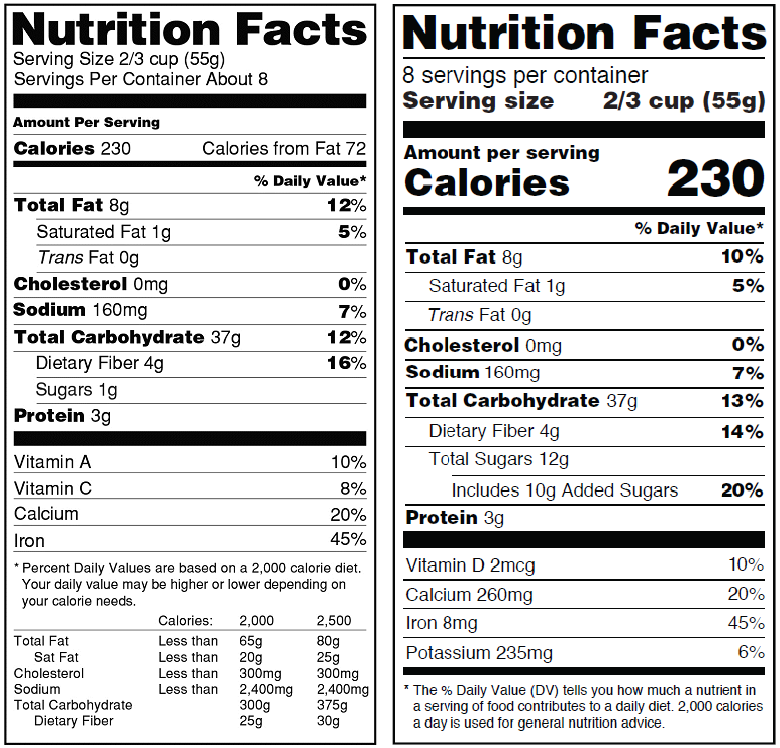
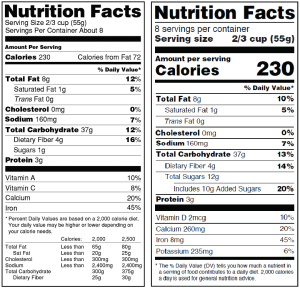
Below is a comparison of the current label to the new one. What do you think? Will it be more user friendly!?!?
-Kelsey
by kelsey | May 18, 2016 | Cooking Tips, Diabetes, Diet, Food, Weight Management, Wellness/Health

I get asked about healthy snack options on a regular basis. Snacking can be included in a healthy diet as long as you are making a good choice and watching your portions. I encourage snacks to have a balance of nutrients–especially healthy carbohydrates and lean proteins to help keep energy levels stable and provide satiety. Give these a try!
- Peanut butter and banana or apple
- Greek yogurt and fruit
- Hummus and carrots
- Low-fat cottage cheese and red pepper
- Snack mix with nuts, oats, and dried fruit
- Oatmeal topped with fruit and nuts
- Beef jerky and apple
- String cheese and whole grain crackers such as Wheat Thins or Triscuits
- Half of a turkey sandwich
- Almonds and fruit
- Yogurt
- Light popcorn
-Kelsey
by kelsey | May 11, 2016 | Cooking Tips, Diet, Food, Weight Management, Wellness/Health

May is beef month so I thought it’d be fitting to talk about this powerhouse lean protein!
Did you know that beef is 20% leaner than it was about 15 years ago? There are at least 29 cuts of lean beef which means they meet the government guidelines for lean, meaning each cut has less than 10g of total fat, less than 4.5 g of saturated fat, and less than 95mg of cholesterol (in a 3 oz serving). Here are some tips for you to make beef a part of your heart healthy meals:
- Look for key words such as “round” or “loin” …these are typically leaner cuts
- Choose 90% or greater lean beef. This means in a 3oz serving there is less than 5g of fat in it.
- Use healthy cooking methods such as grilling, broiling, baking, roasting, or braising. The less tender cuts can be marinated in a tenderizing marinade such as salsa or light Italian dressing.
- Trim the fat! Trimming the fat before cooking will help eliminate some of the fat from the cut.
- Cook with fresh ingredients such as lemon juice, peppers, onions, garlic, and herbs instead of adding extra fat to the cut.
- Practice portion control. Select the 3-5 oz serving over the 10oz.
Balance is key to a healthy diet, so be sure to include your fruits and veggies and whole grains along with your lean meat to create a healthy plate. As of a just a few months ago, all meat is required to have the nutrition content (label) posted by it in the grocery store. Be sure to use this when you’re selecting your cuts of meat and pay special attention to the total fat and saturated fat content. If you want to learn more about the benefits of beef and explore healthy recipes check out these websites: www.beefnutrition.org and www.beefitswhatsfordinner.com.
-Kelsey
by kelsey | May 5, 2016 | Diet, Etc., Weight Management, Wellness/Health

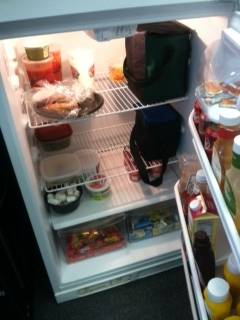
Have you ever thought about how your environment impacts your health, wellness, and choices you make? Believe it or not, our environment plays a huge role with our choices and impact our health positively or negatively. For example, take a look at your fridge and assess the following:
Do you have: a family photo near the door handle, precut fruit on the center shelf, precut veggies on the center shelf, cut up fruit or veggies are in a “see-through” container, salad and veggie leftovers are in transparent containers or plastic wrap, healthiest snacks are on the front middle shelf, less healthy snacks are in the back or lower sides, health snacks such as yogurt, string cheese, eggs, low fat milk, etc are available.
Do you see the theme here? Putting our healthiest items in the front and center of our fridge so that when we open the door, we see them first, will help us make healthier choices! Also- putting those healthy foods in easy to see containers will remind us that we have them available and make them easier to choose. I am sure you all have bought a healthy item such as carrots and they got shoved to the back of the fridge and didn’t get eaten before they expired. It’s that concept of “out of sight, out of mind”….if we aren’t seeing them, we aren’t going to choose them and the fruits and veggies are not prepped initially, we are less likely to choose them as well. This requires a little work, but once we get into the habit of making our environment healthier, it will be easier to make healthier choices!
If you want to learn more about this concept, go check out the book Slim by Design. It’s a good read!
-Kelsey
by kelsey | Apr 28, 2016 | Cooking Tips, Diabetes, Diet, Food, Weight Management, Wellness/Health

Spring and summer bring warmer temps and the desire for more frozen treats! Smoothies are a great way to cool off and get some great nutrients while you’re at it!
Lately there has been an explosion in the media discussing smoothies for weight loss, athletic performance, and meal replacements. Since the supplement industry heavily promotes “quick fixes”, keep in mind that an overall balanced diet is the best way to maintain or improve your health. The goal of many supplement industries is not to fix the problem, but rather to create addiction and increase revenue. Supplements are not regulated by the Food and Drug Administration and claims made for them are not always accurate or proven. However, homemade fruit and vegetable smoothies are way to guarantee your 5-A-Day natural nutrients. Consumption of fruits and vegetables may help prevent chronic diseases such as cancer, heart disease, and diabetes while delivering fiber and vitamins. With a new season upon us, we are gifted with a wider variety of options to choose from when eating the rainbow. Contrary to the common belief, consuming the recommended amounts of fruits and vegetables can be inexpensive and in the long run will save you money in terms of medical bills.
There are endless smoothie recipes you can use to make a quick breakfast, after a workout, or for an afternoon snack. Adding an extra boost to your smoothie such as protein powder or Greek yogurt will additionally provide other valuable nutrients. Here’s a guide to help get started
Add Fruit/Vegetable
|
Add Liquid
|
Add Thickener
|
Extra
|
| Banana, Berries, Apple, Pear, Peach, Kiwi, Pineapple, Cherries, Mango, Orange, Spinach, Kale, Beets, Carrots |
Dairy, Soy, Rice, or Almond Milk, Fruit Juice, Water, Iced Tea |
Peanut butter, Yogurt, Frozen yogurt, ice cubes, or oats. |
Honey, Cinnamon, Protein Powder, Mint, Figs, Dark Chocolate, Flaxseed. |
| Choose 2-3 |
Add 1-2 cups of liquid |
Pick your consistency |
Your preference |
Here are some examples:
Green Smoothie: Mango Chunks, Banana, Kale or Spinach, Apple Slices, Water, Plain low fat yogurt
Carrot Smoothie: Carrots, Orange, Pineapple, Low-sugar Apple Juice, Ice Cubes, Cinnamon
Desert Smoothie: Banana, Apple Slices, Low Fat/Skim Milk, Peanut Butter, Top with Dark Chocolate Shavings
Enjoy!
-Kelsey
by kelsey | Apr 27, 2016 | Cooking Tips, Diet, Food, Weight Management

Our friends at County Fair Foods provided some extra tasty treats for last night’s STRIVE meeting. Be sure to give these recipes a try!
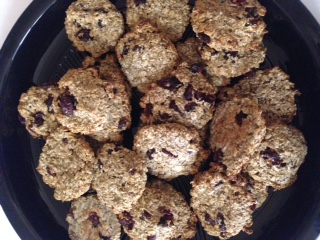
Healthy Banana Cookies (pictured above)
Ingredients: 1 ripe banana, 1 cup rolled oats, raisins or craisins
Directions: Mix and mush all ingredients together and then shape into balls and then flatten them onto a cookie. Bake at 350 for 15-20 minutes.

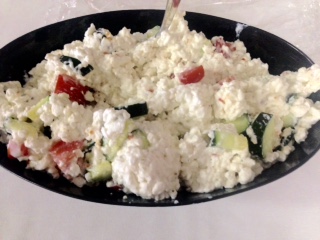
Garden Fresh Cottage Cheese Salad (pictured above)
Ingredients: 2 containers (22oz) of 1% cottage cheese, 1 cucumber diced,1 tomato diced, 1 pkg Good Seasoning Italian Dressing.
Directions: Mix together and put in refrigerator for a few hours before serving. Can serve plain or with whole grain crackers.
Enjoy!!