by kelsey | May 25, 2016 | Diet, Food, Weight Management, Wellness/Health
There is exciting news in the nutrition world this week! We are getting a new and improved nutrition label! The FDA revealed what the new label will look like and the changes are going to be very beneficial to us consumers! Here’s the scoop according to the FDA: http://www.fda.gov/Food/GuidanceRegulation/GuidanceDocumentsRegulatoryInformation/LabelingNutrition/ucm385663.htm
“Highlights of the Final Nutrition Facts Label
1. Features a Refreshed Design
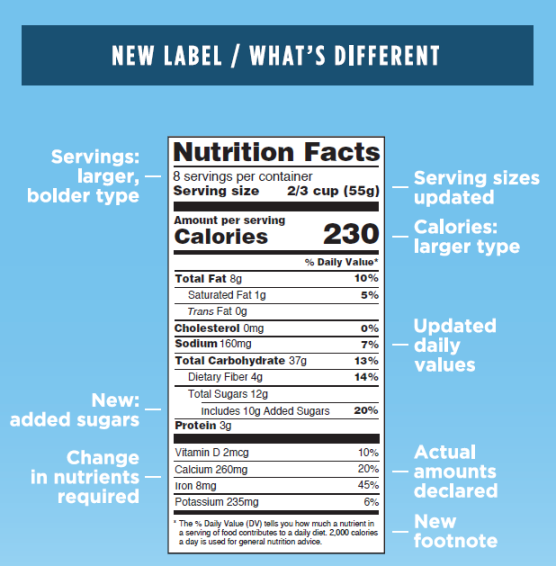
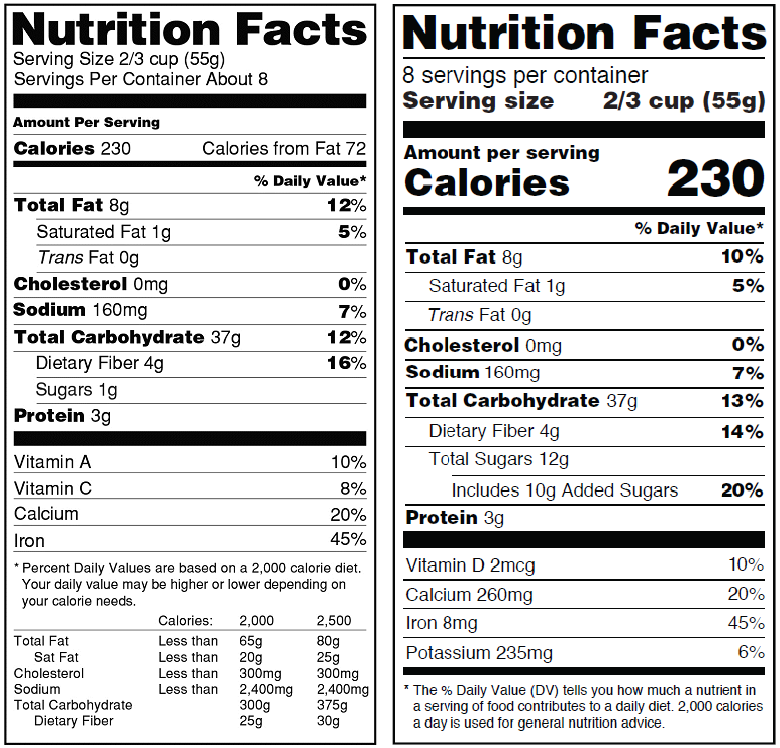
- The “iconic” look of the label remains, but we are making important updates to ensure consumers have access to the information they need to make informed decisions about the foods they eat. These changes include increasing the type size for “Calories,” “servings per container,” and the “Serving size” declaration, and bolding the number of calories and the “Serving size” declaration to highlight this information.
- Manufacturers must declare the actual amount, in addition to percent Daily Value of vitamin D, calcium, iron and potassium. They can voluntarily declare the gram amount for other vitamins and minerals.
- The footnote is changing to better explain what percent Daily Value means. It will read: “*The % Daily Value tells you how much a nutrient in a serving of food contributes to a daily diet. 2,000 calories a day is used for general nutrition advice.”
2. Reflects Updated Information about Nutrition Science
- “Added sugars,” in grams and as percent Daily Value, will be included on the label. Scientific data shows that it is difficult to meet nutrient needs while staying within calorie limits if you consume more than 10 percent of your total daily calories from added sugar, and this is consistent with the 2015-2020 Dietary Guidelines for Americans.
- The list of nutrients that are required or permitted to be declared is being updated. Vitamin D and potassium will be required on the label. Calcium and iron will continue to be required. Vitamins A and C will no longer be required but can be included on a voluntary basis.
- While continuing to require “Total Fat,” “Saturated Fat,” and “Trans Fat” on the label, “Calories from Fat” is being removed because research shows the type of fat is more important than the amount.
- Daily values for nutrients like sodium, dietary fiber and vitamin D are being updated based on newer scientific evidence from the Institute of Medicine and other reports such as the 2015 Dietary Guidelines Advisory Committee Report, which was used in developing the 2015-2020 Dietary Guidelines for Americans. Daily values are reference amounts of nutrients to consume or not to exceed and are used to calculate the percent Daily Value (% DV) that manufacturers include on the label. The %DV helps consumers understand the nutrition information in the context of a total daily diet.
3. Updates Serving Sizes and Labeling Requirements for Certain Package Sizes
- By law, serving sizes must be based on amounts of foods and beverages that people are actually eating, not what they should be eating. How much people eat and drink has changed since the previous serving size requirements were published in 1993. For example, the reference amount used to set a serving of ice cream was previously ½ cup but is changing to ⅔ cup. The reference amount used to set a serving of soda is changing from 8 ounces to 12 ounces.
- Package size affects what people eat. So for packages that are between one and two servings, such as a 20 ounce soda or a 15-ounce can of soup, the calories and other nutrients will be required to be labeled as one serving because people typically consume it in one sitting.
- For certain products that are larger than a single serving but that could be consumed in one sitting or multiple sittings, manufacturers will have to provide “dual column” labels to indicate the amount of calories and nutrients on both a “per serving” and “per package”/“per unit” basis. Examples would be a 24-ounce bottle of soda or a pint of ice cream. With dual-column labels available, people will be able to easily understand how many calories and nutrients they are getting if they eat or drink the entire package/unit at one time.
Compliance Dates
Manufacturers will need to use the new label by July 26, 2018. However, manufacturers with less than $10 million in annual food sales will have an additional year to comply.”
Below is a comparison of the current label to the new one. What do you think? Will it be more user friendly!?!?
-Kelsey
by kelsey | May 19, 2016 | Etc.

Each Friday morning in the summer starting June 3rd.
Free of charge 9:00 a.m. for around an hour each week.
We will walk at a comfortable pace, so come and join the social aspect of being outside with friends and getting some exercise.
June 3 McKinley Park (by the picnic shelter)
June 10 Stokes-Thomas City Park (by the Veterans Memorial)
June 17 Mt. Hope Cemetary (by the front entrance)
June 24 Redlin Art Center (by the front entrance)
July 1 No Walk Scheduled because of the Fourth of July weekend
July 8 Joy Ranch (in parking lot near SE side of Main St.)
July 15 Jackson Park (in the parking lot across from Cattail Crossing)
July 22 Bramble Park Zoo (by the picnic shelter)
July 29 Eastwoods Park (by the playground)
August 5 Slumberland Disc Golf Course (in the parking lot)
August 12 Stokes-Thomas City Park (by the Veterans Memorial)
August 19 No walk scheduled because of the Local Senior Games
August 26 Senior Activities Center (in the park area out front)
For more information call Jeremy at the Park and Rec @ 882-6260
by kelsey | May 18, 2016 | Cooking Tips, Diabetes, Diet, Food, Weight Management, Wellness/Health

I get asked about healthy snack options on a regular basis. Snacking can be included in a healthy diet as long as you are making a good choice and watching your portions. I encourage snacks to have a balance of nutrients–especially healthy carbohydrates and lean proteins to help keep energy levels stable and provide satiety. Give these a try!
- Peanut butter and banana or apple
- Greek yogurt and fruit
- Hummus and carrots
- Low-fat cottage cheese and red pepper
- Snack mix with nuts, oats, and dried fruit
- Oatmeal topped with fruit and nuts
- Beef jerky and apple
- String cheese and whole grain crackers such as Wheat Thins or Triscuits
- Half of a turkey sandwich
- Almonds and fruit
- Yogurt
- Light popcorn
-Kelsey
by kelsey | May 17, 2016 | Etc.
A support and education group for people with Irritable Bowel Syndrome (IBS) has scheduled an organizational meeting on June 2nd at 6:30pm at the west conference room of Prairie Lakes Hospital.
The group will work to educate those who are living with IBS and to increase awareness of the disorder. IBS is a functional bowel disorder characterized by recurrent abdominal pain and diarrhea, constipation, or a combination of both. It is more prevalent in women than men by a 2:1 ratio. The cause is unknown. There is no cure for IBS.
The group will focus on sharing experiences and discussing symptom management through medication, diet, exercise, and stress reduction. Those attending should use the main hospital entrance and ask at the information desk for directions to the west conference room. Attendance is free! The group is intended for IBS only, not for those with other gut disorders such as inflammatory bowel disease or colon cancer.
If you have any questions you can contact Bruce Ford at 880-5213 or Kris Munger at Prairie Lakes Hospital.
by kelsey | May 11, 2016 | Cooking Tips, Diet, Food, Weight Management, Wellness/Health

May is beef month so I thought it’d be fitting to talk about this powerhouse lean protein!
Did you know that beef is 20% leaner than it was about 15 years ago? There are at least 29 cuts of lean beef which means they meet the government guidelines for lean, meaning each cut has less than 10g of total fat, less than 4.5 g of saturated fat, and less than 95mg of cholesterol (in a 3 oz serving). Here are some tips for you to make beef a part of your heart healthy meals:
- Look for key words such as “round” or “loin” …these are typically leaner cuts
- Choose 90% or greater lean beef. This means in a 3oz serving there is less than 5g of fat in it.
- Use healthy cooking methods such as grilling, broiling, baking, roasting, or braising. The less tender cuts can be marinated in a tenderizing marinade such as salsa or light Italian dressing.
- Trim the fat! Trimming the fat before cooking will help eliminate some of the fat from the cut.
- Cook with fresh ingredients such as lemon juice, peppers, onions, garlic, and herbs instead of adding extra fat to the cut.
- Practice portion control. Select the 3-5 oz serving over the 10oz.
Balance is key to a healthy diet, so be sure to include your fruits and veggies and whole grains along with your lean meat to create a healthy plate. As of a just a few months ago, all meat is required to have the nutrition content (label) posted by it in the grocery store. Be sure to use this when you’re selecting your cuts of meat and pay special attention to the total fat and saturated fat content. If you want to learn more about the benefits of beef and explore healthy recipes check out these websites: www.beefnutrition.org and www.beefitswhatsfordinner.com.
-Kelsey